

Finding the best chest protector motocross riders actually need starts with a distinction most buying guides skip entirely: a roost guard and a genuine impact-rated chest protector are not the same product, even though they often look nearly identical on a shelf. One is built to deflect small debris; the other is built to absorb real crash force. Mixing the two up means either overpaying for protection you don't need, or worse, assuming you're covered for an impact when your gear was only ever rated for flying dirt.
This guide breaks down what each piece of MX body armor actually does, plus the real, genuinely unsettled debate around neck braces. Browse Perf-Moto's protective gear lineup as you read through what fits your riding.
Quick Takeaways
- Roost guards and chest protectors are certified under completely different standards. One tests debris deflection; the other tests real impact force.
- Chest protectors need to cover specific zones, not just the center of your chest, to actually do their job in a fall.
- Airbag chest protection is now a real, purchasable option for motocross, not just a road-racing technology.
- The neck brace debate is genuinely unsettled, not a simple yes-or-no, and even the injury data gets interpreted differently depending on the source.
- A neck brace only works with a compatible chest protector. Buying one without the other undermines the point of both.
Roost Guard vs. Chest Protector: They're Not the Same Thing
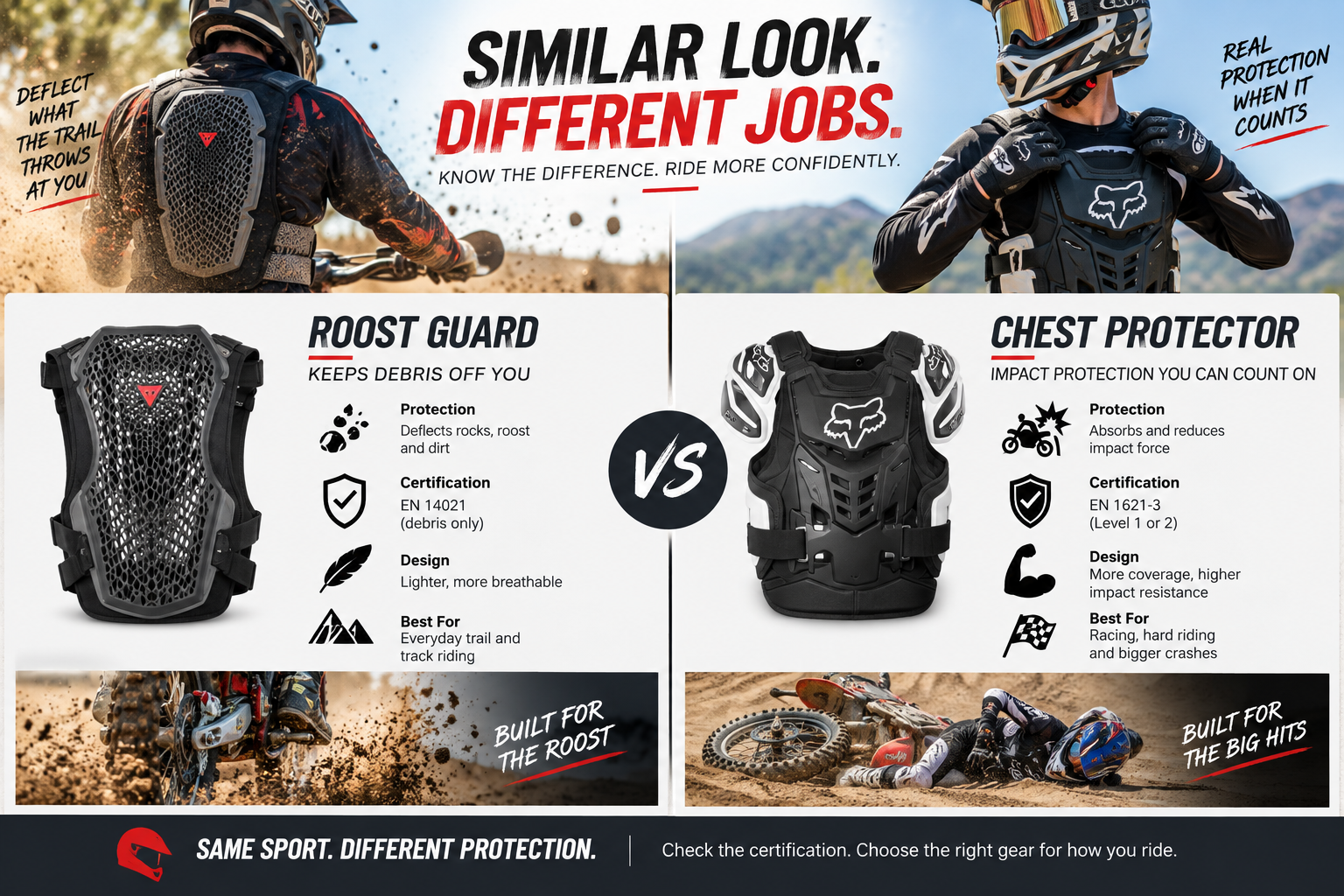
This is the distinction most riders never get a clear answer on. Roost guards, sometimes called stone shields, are certified under EN 14021, a standard specifically built to test protection against small, sharp debris, thrown rocks, dirt clods, and roost kicked up by another rider's tire.
According to the official EN 1621-3 standard documentation, EN 14021 is explicitly the standard to look for when a product is "only intended to protect against lofted stones," as distinct from genuine impact protection.
A real chest protector, by contrast, is certified under EN 1621-3, the actual motorcyclist impact-protection standard. According to SATRA, a testing lab involved in developing these standards, EN 1621-3 measures how much force a chest protector transmits to your body during a genuine impact, not just whether it deflects debris, with separate Level 1 and Level 2 performance tiers similar to the limb and back armor standards covered elsewhere in motorcycle gear.
The practical takeaway: a roost guard alone is not a substitute for real impact protection, even though the two product categories often look almost identical from across a shop floor. Check which standard a specific product is actually certified under before assuming coverage you don't have.
What Do MX Chest Protectors Actually Do?
A properly rated chest protector covers your sternum, ribs, and often your back and shoulders, absorbing and spreading impact force across a wider area rather than letting it concentrate on one point of contact. Perf-Moto's Leatt 2.5 Chest Protector is a real example built specifically around this: CE tested under EN 14021, with a hard-shell front and back plate and an adjustable harness of waist and shoulder straps designed to keep the plates positioned correctly even as you move on the bike.
For riders wanting genuine crash-force impact protection rather than roost deflection alone, Fox Racing's Raptor CE chest protector and Alpinestars' Bionic Action both build in genuine hard-shell front and rear plates with bio-foam backing, aimed at real impact absorption rather than just deflecting debris.
How Should an MX Chest Protector Fit?
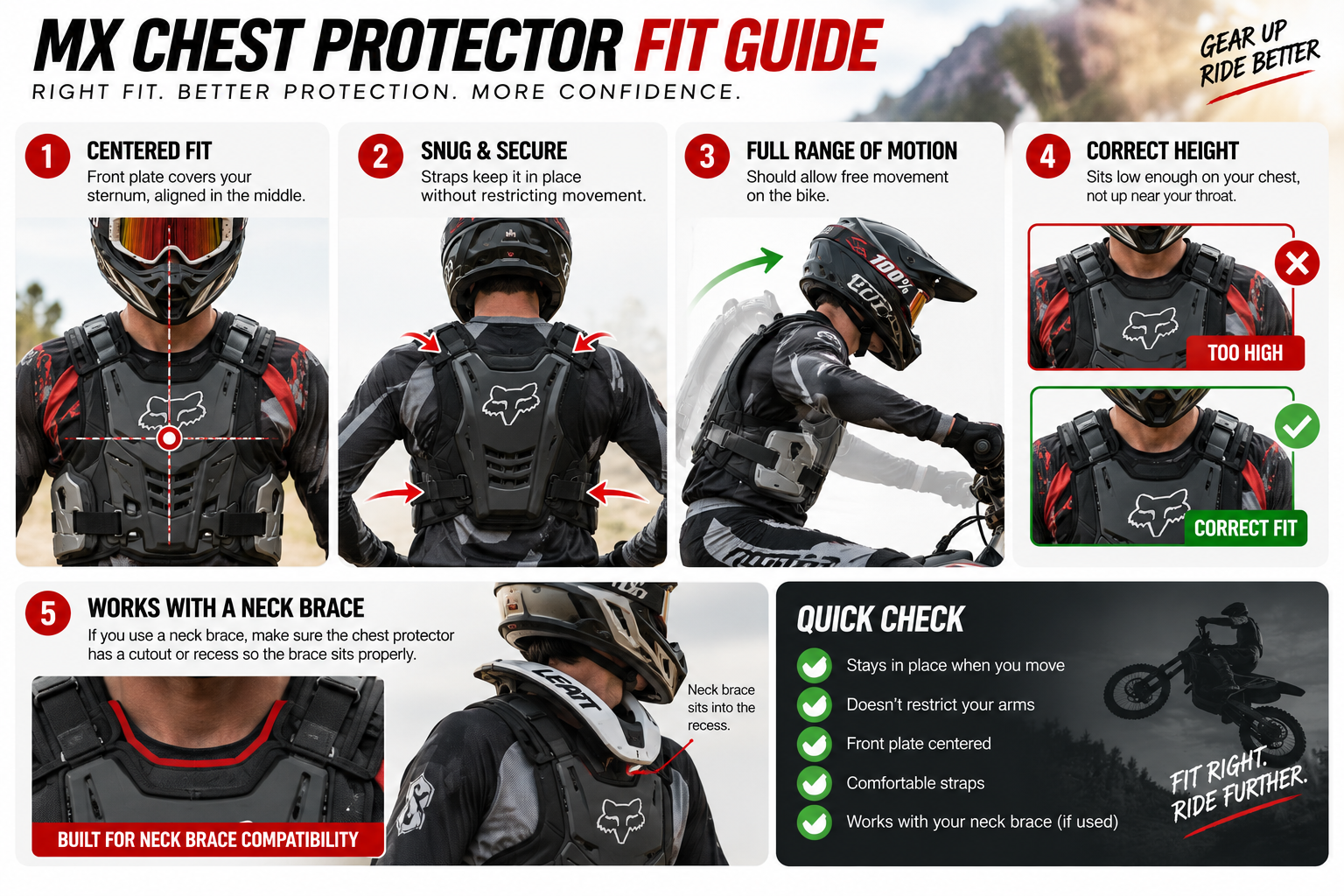
A chest protector needs to sit snugly enough that the plates stay positioned over your sternum and shoulder blades through a full range of riding motion, not just standing still in a shop mirror. Adjust the harness straps so the front plate sits centered on your chest without riding up toward your throat or shifting to one side when you twist, and check that the shoulder straps don't dig in or restrict your arms reaching forward to the bars.
If you're also running a neck brace, fit gets more specific: the chest protector needs a recess or cutout that the brace's front strut actually seats into, rather than the two pieces fighting each other for space. Several chest protectors, including the Leatt models above, are built with that integration in mind specifically.
Read Also: How Should a Motorcycle Jacket Fit? The Real Answer, Plus CE Armor Levels Explained
The Next Level: Airbag Chest Protection
Airbag protection, long established in road racing, has genuinely arrived in motocross too. Alpinestars' Tech-Air MX System is a real, purchasable autonomous airbag vest built specifically for motocross and supercross riders, deploying automatically to cover the shoulders, chest, and back the moment its sensors detect a crash, with a USB-C rechargeable system and an LED display showing battery and riding mode status.
It's a genuinely different category from a passive hard-shell chest protector, worth knowing about even if the price point puts it a tier above entry-level gear.
Neck Braces: Are They Worth It?
This is where the real debate lives, and it's worth being honest that it's genuinely unsettled rather than pretending there's a clean answer. An academic study published in The Sport Journal found that despite evidence pointing toward reduced cervical injury risk with neck brace use, actual adoption among riders remains limited, driven by physical discomfort, personal past experiences, and genuine skepticism about how well the devices work in practice, not just laziness or ignorance of the research.
Manufacturers make specific injury-reduction claims. Perf-Moto's Leatt 5.5 Adult Neck Brace cites an independent off-road study reporting up to an 89 percent reduction in critical cervical spine injuries among brace wearers, a figure worth knowing but also worth treating as a manufacturer-cited statistic rather than an independently re-verified number, since it comes from Leatt's own product page.
What's genuinely true either way: a neck brace is designed to limit the extreme forward, backward, and sideways head movement that causes the most severe cervical spine injuries, and it's built to work specifically alongside a compatible chest protector rather than as a standalone piece.
Common concerns worth addressing honestly: discomfort and an adjustment period are real for most riders; restricted head movement takes getting used to, and the clavicle-injury question specifically gets reported differently depending on the source. Some describe a small increased clavicle risk from load transfer; others report the opposite in their data.
If you're on the fence, that's a reasonable place to be, and trying one on with your actual helmet and chest protector before committing is worth more than reading another opinion online.
Perf-Moto carries neck braces across adult, youth, and carbon options if you decide it's right for you.
Frequently Asked Questions
What is the best MX chest protector?
There isn't one universal answer, since "best" depends on whether you need genuine EN 1621-3 impact protection or are mainly looking for roost deflection, and whether you're pairing it with a neck brace. A hard-shell EN 1621-3-rated protector like the Fox Raptor CE or Alpinestars Bionic Action makes sense for real impact coverage; a lighter EN 14021 roost guard suits riders mainly concerned with debris on the track.
What are the differences between a roost protector and a chest protector, and which one is better for me?
A roost protector (certified EN 14021) is built to deflect small debris like rocks and dirt clods; a genuine chest protector (certified EN 1621-3) is built to absorb real impact force in a fall. Neither is universally "better." If you're mainly worried about roost on a dusty track, a roost guard is lighter and cooler. If you want real crash protection, look specifically for EN 1621-3 certification rather than assuming any hard-shell product covers you the same way.
Gear Up for the Hit You Don't See Coming
Roost, falls, and getting landed on by another rider are three different hazards, which is exactly why Perf-Moto carries body armor built for each one separately rather than a single one-size-fits-all solution. Knowing which standard your gear is actually certified under matters more than how tough it looks.
Not sure whether you need a roost guard, a full impact-rated chest protector, or both? Ask the team, Monday through Friday, 9 am to 5 pm EST.
Shop chest protectors, roost guards, and neck braces, and check certification before you buy.