
Here's a scenario almost every rider's lived through: you try on a jacket, catch yourself in the mirror, and think it runs a size small. Shoulders feel tight, arms feel restricted, so you size up. Then you get it home, throw a leg over the bike, lean forward onto the bars, and suddenly that "too small" jacket fits like it was made for you.
That's not a fluke, and it's not you being bad at buying gear. It's the actual, specific reason so many riders end up either restricted in a jacket that's technically too big, or fighting armor that's crept out of place in one that's technically "right."
So how should a motorcycle jacket fit? Snug enough that the armor stays exactly where it belongs over your shoulders, elbows, and spine, loose enough that you can move and layer underneath, and judged in riding position, not standing straight up in front of a mirror. But fit is only half of what actually keeps you protected. A jacket can fit perfectly and still have armor that's barely doing its job, which is where CE Level 1 and Level 2 ratings come in.
That number on the tag isn't a marketing tier. It's a measurable difference in how much force reaches your body if you go down.
This guide covers both halves properly: getting the fit right once you factor in riding position, and understanding exactly what those armor level numbers mean before you buy. Browse Perf-Moto's riding jackets once you've got a feel for what to look for.
Quick Takeaways
- Snug through the torso and shoulders, correct sleeve length only in riding position. Standing straight up in a store mirror is the wrong way to judge a motorcycle jacket's fit.
- Jackets run small on purpose, not by accident. They're cut for a forward-leaning, arms-bent riding posture, which feels tight when you're standing upright.
- CE Level 2 armor transmits less force than Level 1. That makes it more protective, at the cost of a bit more bulk and stiffness.
- Back protectors and elbow armor are tested under two different standards, EN 1621-2 and EN 1621-1 respectively, with different force thresholds for each.
- Too big is just as much of a problem as too small. Loose armor shifts away from your joints in exactly the moment it needs to be in place.
How Should a Motorcycle Jacket Fit? Snug in the Right Places
Think of it less like buying a jacket and more like buying a blazer that has to survive a fall. The torso and shoulders should feel snug without restricting your breathing or reach. Sleeve length is where motorcycle jackets genuinely diverge from ordinary ones, and it's the detail that trips people up most: don't judge sleeve length with your arms hanging at your sides.
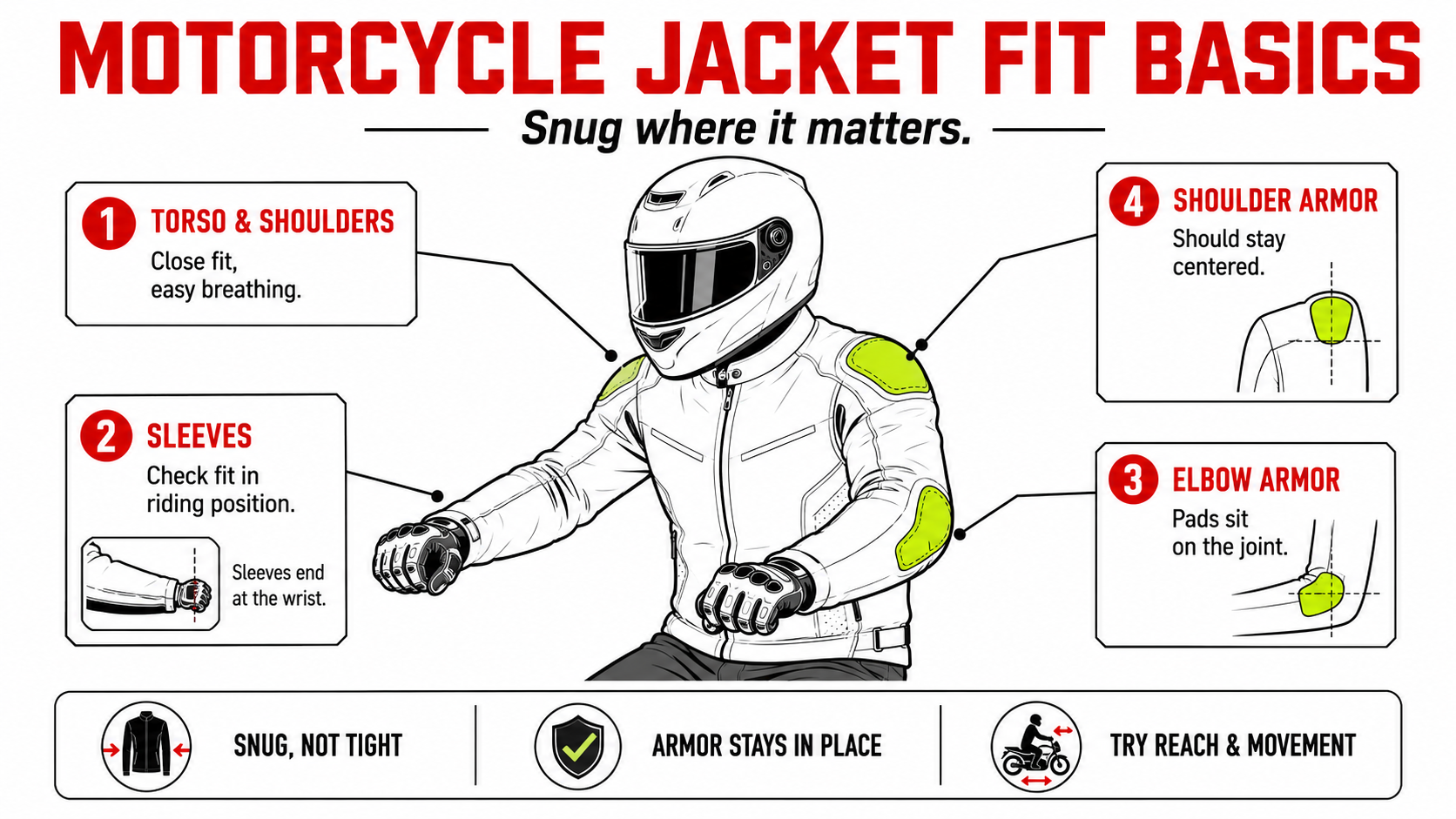
Extend them forward like you're gripping handlebars, and check it there instead. A jacket that looks a little short-sleeved standing normally is often dead-on once your arms are actually where they'll be on the bike.
Armor placement is just as important as overall snugness, arguably more so. Shoulder and elbow armor should land directly over the joint without you having to shift it into place, and it shouldn't wander more than slightly when you move your arms around. If the armor's sitting an inch off from your actual elbow or shoulder, tightening the jacket everywhere else won't fix that. At that point you're probably looking at a different size, or a jacket with adjustable armor positioning.
Perf-Moto's Alpinestars Acumen jacket is worth a look if you want a serious riding jacket built around exactly that kind of adjustability; check the product page for its specific armor rating and available sizes before you buy.
Why Do Motorcycle Jackets Run Small? The Riding Position Explanation
This is one of the most common complaints about riding jackets, and there's a real reason behind it, not just inconsistent sizing across the industry. These jackets are cut and articulated for a forward-leaning torso with slightly bent arms, which is the position you're actually in on a bike, not the neutral standing position you're in while trying one on at home or in a store.
That pre-curved cut is exactly why a jacket can feel tight across the shoulders or a bit short in the arms while you're standing up straight, then feel completely normal the second you lean forward and bend your arms like you're reaching for the bars. So before deciding a jacket doesn't fit, try it in that actual position, ideally sitting on the bike itself, or at least mimicking the posture.
Nine times out of ten, the size that felt wrong standing straight turns out to be exactly right once you're in the position you'll actually wear it in.
CE Armor Levels Explained: Level 1 vs. Level 2
Impact armor gets tested and rated under the EN 1621 family of standards, and the number on the tag tells you specifically how much force actually reaches your body during an impact. According to SATRA, the lab that helped develop these standards, testing involves dropping a weighted mass onto the armor and measuring how much force a sensor behind it records.
For limb armor (shoulders, elbows, hips, knees) under EN 1621-1:
- Level 1: mean transmitted force below 35 kN, peak below 50 kN.
- Level 2: mean transmitted force below 20 kN, peak below 30 kN.
Lower numbers are better here; less force reaching your body means more protection, so Level 2 is the higher tier. The usual tradeoff is bulk: a Level 2 pad often needs more material to absorb that extra force, which can make it a bit stiffer or thicker than an equivalent Level 1 pad. That gap has closed a lot with newer materials, though, so it's worth actually comparing the specific product rather than assuming every Level 2 pad is automatically bulkier.
Back Protectors and Elbow Armor: Where Fit Matters Most
Back protectors get their own separate standard, EN 1621-2, with its own thresholds: Level 1 at 18 kN mean transmitted force, Level 2 at 9 kN. That's roughly half the force getting through at Level 2, which is a real jump when you're talking about protection for your spine specifically.
Fit matters more here than almost anywhere else on the jacket, because these two spots are the ones most likely to shift out of place when things are loose. A back protector that's ridden up or twisted to one side isn't covering the section of spine it's supposed to. Elbow armor that's migrated down toward your forearm because the sleeve's too loose isn't doing much for your actual elbow in an impact.
If your jacket's stock armor still isn't sitting right even after adjusting every strap, back protectors and elbow and shoulder guards are both sold separately as upgrades or replacements.
Too Big or Too Small? Why Both Are a Problem
Sizing up feels like the safe choice: more room, more comfort, space to layer. But a jacket that's too big lets armor shift and drift away from your joints, which is the exact failure mode described above. Loose fabric at speed also flaps and adds wind noise it wouldn't otherwise have. Sizing up specifically to solve an armor-placement problem usually just relocates that same problem somewhere else.

Go too small, on the other hand, and you lose the arm movement and torso rotation you actually need on a bike, plus any room for a base or mid layer underneath once it gets cold. Tight seams also take on more stress if you go down, which isn't where you want a jacket's structural integrity being tested for the first time.
The sweet spot sits right between those two failure points: snug enough that armor stays put, and nothing's flapping around, loose enough to move freely and add a layer when the weather turns.
Frequently Asked Questions
Is Level 1 or Level 2 better for motorcycle armor?
Level 2, by the numbers. It transmits less force to your body in the same impact, roughly 20 kN versus 35 kN mean force for limb armor, and 9 kN versus 18 kN for back protectors. Level 1 tends to run thinner and more flexible, which some riders genuinely prefer for comfort, especially in hot weather. Neither is unsafe. Level 2 is just the higher-protection tier of the same standard.
How is a motorcycle jacket supposed to fit?
Snug through the torso and shoulders without restricting breathing or reach, with sleeve length checked in riding position, arms extended forward and slightly bent, not standing straight. Armor should sit directly over your shoulders, elbows, and spine without noticeably shifting when you move.
What is Level 2 motorcycle armor?
It's the higher protection tier under the EN 1621 standards, meaning less force reaches your body in an impact compared to Level 1. For limb armor, that's a mean transmitted force below 20 kN; for back protectors, below 9 kN.
Is it better for a jacket to be too big or too small?
Neither, honestly; they just fail in different ways. Too big lets armor shift away from your joints and adds a fabric flap at speed. Too small restricts movement and kills your ability to layer underneath in the cold. Aim for snug through the torso and shoulders with correct sleeve length in riding position, not whichever extreme feels safest off the bike.
Try It the Way You'll Actually Ride It
A motorcycle jacket might be the single hardest piece of gear to judge correctly standing in front of a mirror, which is exactly why Perf-Moto's guaranteed-fitment policy exists in the first place. If a jacket that felt right in your living room turns out wrong once you're actually leaning over the bars, that's a genuinely common outcome, not a mistake on your part.
Not sure if your measurements match a specific jacket's cut? Ask the team first, Monday through Friday, 9 am to 5 pm EST.
Shop CE-rated protective gear and armor upgrades if your current jacket's fit or armor isn't cutting it anymore.