
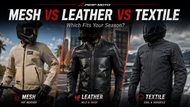
Here's the thing nobody tells you when you're shopping for your first real riding jacket: there isn't one correct answer to mesh vs leather motorcycle jacket, because the three materials aren't really competing for the same job. A jacket built to keep you cool at 95 degrees and a jacket built to keep rain off you at 45 degrees are solving completely different problems, and buying one to handle both usually means it does neither particularly well.
Add leather into that mix, with its own specific reputation and tradeoffs, and it's easy to end up overwhelmed by options that all sound reasonable in a product description.
So let's actually sort it out by what each material is genuinely good at, not just what looks tough on a showroom floor. Browse the full range of riding jackets as we go through mesh, leather, and textile one at a time.
Quick Takeaways
- Mesh wins on hot-weather ventilation, full stop, and it's the clear answer if riding in real heat is your main problem to solve.
- Leather still leads on pure abrasion resistance, which is exactly why it never fully went away despite decades of textile innovation.
- Textile is the practical all-rounder, especially with a removable waterproof or thermal liner, at the cost of being the best at any one specific thing.
- Waterproofing and ventilation are usually a tradeoff, not a package deal. A jacket built to breathe well in heat rarely also seals out rain well, and vice versa.
- Most serious riders end up owning more than one jacket. Buying for the worst-case weather you'll ever ride in means overheating on every easy summer day in between.
Mesh Jackets: The Answer to Best Motorcycle Jacket for Hot Weather
If you're specifically looking for the best motorcycle jacket for hot weather, mesh is where you land, and it's not close. A mesh jacket's outer shell is built from perforated or open-weave fabric panels specifically to let air move directly through the jacket rather than just around it, which matters enormously once temperatures climb into the 90s.
The Icon Mesh AF CE jacket, sold at Perf-Moto, is built almost entirely around that idea, with large mesh front and rear panels housing a full set of D3O impact protectors, so you're not sacrificing armor to get the airflow. If you want a bit more adjustability alongside that ventilation, the Scorpion Drafter 2 pairs a durable poly mesh shell with CE-approved ventilated armor and a removable windproof liner, so it doesn't become useless the moment the temperature drops in the evening.
The honest limitation: mesh trades away weather resistance to get that airflow. Most mesh jackets handle a light drizzle reasonably well thanks to the armor and denser panels, but they're not built for sustained rain, and the same open weave that keeps you cool does very little to block wind chill once the sun goes down.
Leather Jackets: Why the Oldest Option Still Holds Up
Why do bikers always wear leather jackets? Part of it is genuinely functional, and part of it is a century of cultural momentum that started with pure practicality and never fully let go. Leather's association with motorcycling actually started with WWI-era flight jackets, built for pilots who needed something durable and wind-resistant at altitude.
According to MotorBiscuit's coverage of the jacket's history, it was a New York jacket maker named Irving Schott who adapted that concept specifically for motorcyclists in the 1920s, creating the "Perfecto" jacket that's still recognizable in leather jackets sold today. Marlon Brando wearing one in The Wild One in 1953 cemented the cultural association that leather and biker identity carry to this day, but the functional reason it caught on in the first place was straightforward abrasion resistance.
That functional reputation still holds up under real testing. Independent abrasion testing from organizations like MotoCAP consistently shows quality leather performing well against sustained sliding contact, which is exactly the failure mode a crash actually creates. For a real example, Perf-Moto's RST S-1 CE jacket uses drum-dyed cowhide leather with perforated inserts and a neoprene collar and cuffs, built specifically to hold up to abrasion without becoming unbearable in warmer weather thanks to those perforated panels.
The tradeoff hasn't changed either: leather is heavier than mesh or textile, doesn't breathe as well even with perforation, and needs actual care and conditioning over its lifespan the way synthetic materials don't.
Textile Jackets: The All-Season Compromise
Textile jackets exist specifically to solve the problem mesh and leather each create on their own: needing one jacket that handles more than one type of weather. Most modern textile jackets combine a durable outer shell (often a blend of denier-rated nylon or polyester with abrasion-resistant panels at high-impact zones) with a removable thermal liner and a separate removable waterproof liner, letting you reconfigure the same jacket across a genuinely wide temperature range.
Perf-Moto's Rev'It Tornado 4 H2O is a clean example of this approach done well: drop the thermal liner and open the 3D air mesh panels when it's hot, zip the waterproof liner back in when a storm rolls through. If you want even more ventilation built into the shell itself for genuinely hot climates while keeping a full waterproof option in reserve, the RST Pro Series Adventure-X leans harder into that huge-vent, adventure-touring approach with CE Level 2 armor built in.
The honest tradeoff with textile: it's rarely the absolute best at any single thing. A dedicated mesh jacket will out-ventilate a textile jacket in real heat, and a dedicated leather jacket will generally out-perform textile on pure abrasion resistance. What textile buys you is not having to own three jackets to cover three kinds of weather.
Mesh vs Leather vs Textile: Quick Comparison
|
Mesh |
Leather |
Textile |
|
|
Best for |
Hot weather, summer riding |
Abrasion resistance, classic style |
Variable weather, touring |
|
Ventilation |
Excellent |
Limited, even perforated |
Good, varies by model |
|
Waterproofing |
Poor to none |
Poor, needs treatment |
Good with liner installed |
|
Abrasion resistance |
Moderate |
Excellent |
Good, varies by denier rating |
|
Weight |
Lightest |
Heaviest |
Middle |
Frequently Asked Questions
Which is better for motorcyclists, a mesh jacket or a leather jacket?
Neither is universally better; they're built for different conditions. Mesh wins clearly for hot-weather riding and airflow. Leather wins clearly for pure abrasion resistance and has the added benefit of decades of proven durability. If you ride primarily in heat, go mesh. If crash protection and longevity matter more than comfort on a 95-degree day, leather still holds up.
What material is best for a motorcycle jacket?
There's no single best material across all conditions, only the best material for your specific riding pattern. Hot climate or summer-only riding points toward mesh. Year-round riding in variable weather points toward textile with a removable liner system. A preference for maximum abrasion resistance and classic styling points toward leather.
Is leather or textile better for motorcycle gear?
Leather generally edges out textile on raw abrasion resistance, while textile wins on versatility and weather adaptability thanks to removable liners. Textile has also closed the gap considerably in recent years with higher-denier fabrics and reinforced impact zones, so the abrasion advantage isn't as wide as it used to be.
Which is better, textile or mesh?
Depends entirely on climate and season. Mesh outperforms textile on pure ventilation in hot weather. Textile outperforms mesh the moment weather turns cold or wet, since most textile jackets include a real waterproof liner option that mesh jackets simply don't have.
Are mesh motorcycle jackets worth it?
Yes, specifically if you ride somewhere hot or primarily in summer. A mesh jacket with real CE armor gives you legitimate protection without the heat exhaustion risk of wearing a non-ventilated jacket in serious summer temperatures. It's not worth it as your only jacket if you also ride through cold or wet conditions regularly.
Why do bikers always wear leather jackets?
A mix of genuine function and a century of cultural momentum. Leather's abrasion resistance made it a practical choice for riders long before synthetic textiles existed as an alternative, and its association with pilots' flight jackets and later Marlon Brando's image in The Wild One turned it into a cultural symbol that outlasted the era when it was the only good option available.
One Rider, Multiple Jackets: Building a Wardrobe by Season
Most riders who've been at this a while don't own one jacket; they own two or three, each solving a different weather problem, and that's not overbuying; it's just how riding actually works across a real year. Perf-Moto carries mesh, leather, and textile jackets side by side specifically because the right answer changes with the season, not because one material has quietly won.
Not sure which material fits how you actually ride? Ask the team, Monday through Friday, 9 am to 5 pm EST.
Shop mesh, leather, and textile jackets and filter by material, armor level, and season.