

If you're looking for the best Bluetooth motorcycle intercom, you'll keep seeing the same two names: Sena and Cardo. Both have been building motorcycle communication systems for well over a decade, and both are genuinely good at it, which is exactly why the "which one should I buy" question doesn't have a clean one-word answer.
What actually matters is understanding a few real technical differences, mesh versus standard Bluetooth chief among them, and matching that to how you actually ride: solo with occasional calls, a duo pairing with your passenger, or a full group that spreads out across a mountain road.
This guide covers the real differences between the two brands, what mesh technology actually changes versus plain Bluetooth, and what battery and range numbers really mean once you're riding instead of reading a spec sheet.
Browse communication systems and headsets as you read through what fits your riding group.
Quick Takeaways
- Mesh and Bluetooth solve the group-riding problem differently. Bluetooth intercoms daisy-chain riders together; mesh systems let every unit talk to every other unit directly, and reconnect automatically when someone rides back into range.
- Neither brand is a clean "one is better" answer. Sena and Cardo both make excellent hardware; the real decision comes down to your group size, whether you want a standalone unit or a fully integrated smart helmet, and which ecosystem your riding buddies already use.
- Range numbers on the box are best-case, open-terrain figures. Hills, buildings, and helmet design all cut into real-world range.
- Pairing is a one-time setup, not a per-ride hassle, once you're through the initial companion-app configuration.
- Cross-brand pairing generally works over standard Bluetooth, even though mesh-specific features only work between units of the same brand's mesh network.
Mesh vs Bluetooth: The Real Technical Difference
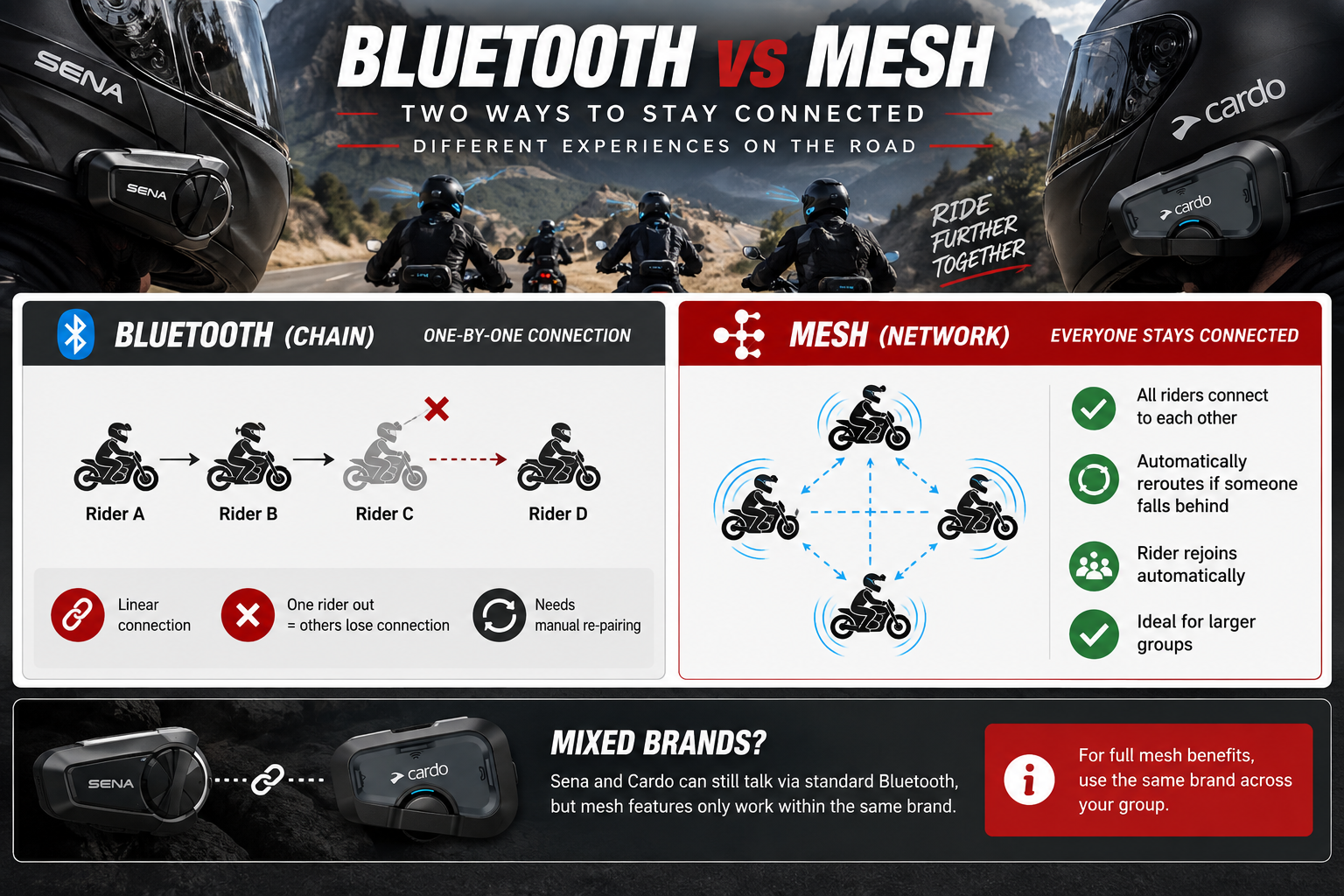
Standard Bluetooth intercoms connect riders in a chain: rider A talks to rider B, who relays to rider C, and so on down the line. The problem shows up the moment one rider in the middle drops out of Bluetooth range, gets stuck at a light, or falls back to take a photo. Everyone beyond that gap in the chain loses the conversation, and reconnecting usually means everyone stopping to re-pair.
Mesh networking, which both Sena and Cardo market under their own branded names (Sena's Mesh Intercom, Cardo's Dynamic Mesh Communication or DMC), solves this differently. Instead of one chain, every unit in the group continuously broadcasts to and listens for every other unit within range, and the network automatically reroutes around gaps.
A rider who falls behind and out of range simply reconnects automatically once they're back in range, without anyone needing to stop and reset anything. This is the single biggest functional upgrade mesh brings over standard Bluetooth, and it's specifically why larger group rides lean on it.
The tradeoff: mesh-specific features only work between units running the same brand's mesh protocol. A Sena mesh unit and a Cardo DMC unit can generally still talk to each other over standard universal Bluetooth pairing, just without the self-healing mesh behavior, so a mixed-brand group defaults down to old-fashioned Bluetooth chain behavior for the whole ride.
Sena vs Cardo: Which One Is Actually Better?
Neither brand wins outright, and here's what that actually means in practice rather than as a dodge.
Sena has leaned further into fully integrated smart helmets alongside its standalone units. The Sena Phantom builds Mesh Intercom 3.0 and Bluetooth 5.3 directly into a DOT- and ECE 22.06-certified fiberglass shell, with Harman Kardon-tuned speakers, a 2.0km open-terrain mesh range, and a claimed 35 hours of talk time.
The Sena Impulse does the same in a modular format, with group mesh supporting up to 24 riders. If you'd rather add communication to a helmet you already own, the Sena 20S EVO HD is a standalone unit with upgraded HD speakers and a fixed shark-fin antenna for more stable range than older flip-up designs.
Cardo's lineup is built primarily around standalone units that mount to whatever helmet you're already riding in, rather than fully integrated smart helmets. Their Packtalk line runs on Dynamic Mesh Communication, and Perf-Moto carries the Cardo Packtalk Outdoor Duo, which shares the same DMC mesh technology as Cardo's motorcycle-focused units: IP67 waterproofing, connection for up to 15 users, and a claimed 5km group range in open terrain.
If you're upgrading the audio on an existing Cardo unit rather than buying a new one, Cardo's JBL 45mm HD speakers are sold separately and fit most communicators on the market, not just Cardo's own.
The practical decision point isn't really "which brand is better." It's whether you want a helmet with everything built in from the factory (Sena's stronger category) or a standalone unit you can move between helmets or pair with existing gear (both brands compete well here, though Cardo's lineup skews more heavily toward this format).
Pairing: Setting Up Your Intercom the First Time
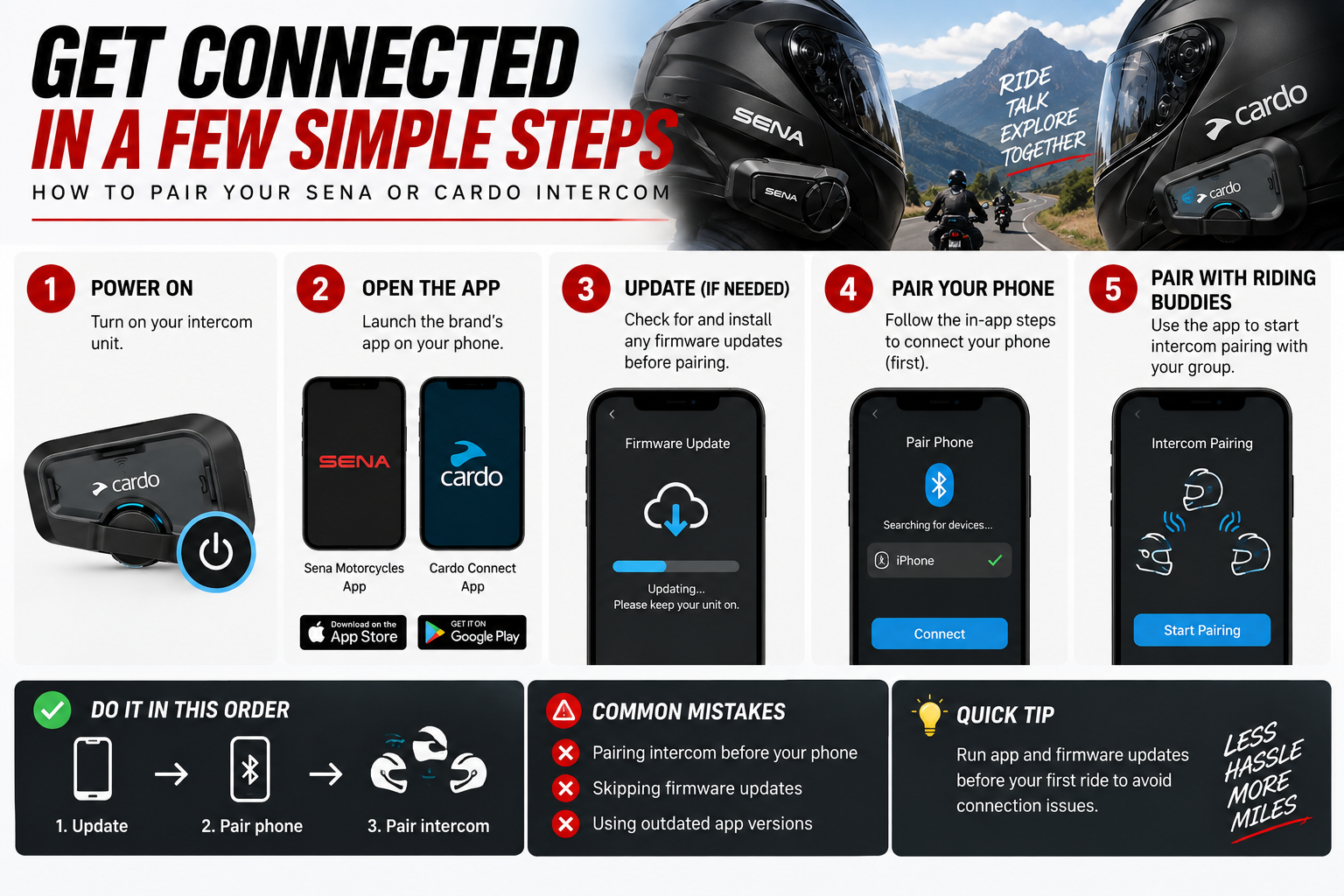
Both brands handle initial setup through a companion phone app rather than the unit's physical buttons alone. Sena uses its own app ecosystem for firmware updates and settings; Cardo uses the Cardo Connect app for the same purpose, plus control over Dynamic Mesh settings, audio mixing, and over-the-air software updates.
The general pairing flow looks similar across both brands: power on the unit, open the app, follow the in-app pairing sequence for phone connectivity first, then run the separate intercom-pairing sequence with your riding partners' units.
The part that trips people up isn't the pairing itself; it's doing phone pairing and intercom pairing in the wrong order, or forgetting that a firmware update sometimes needs to finish before intercom pairing will complete successfully. Running any pending app updates before your first group ride saves a genuinely common headache.
Raed Also: Full-Face vs Modular vs Open-Face Helmets: Which Is Right for You
Battery Life and Range: What the Numbers Actually Mean
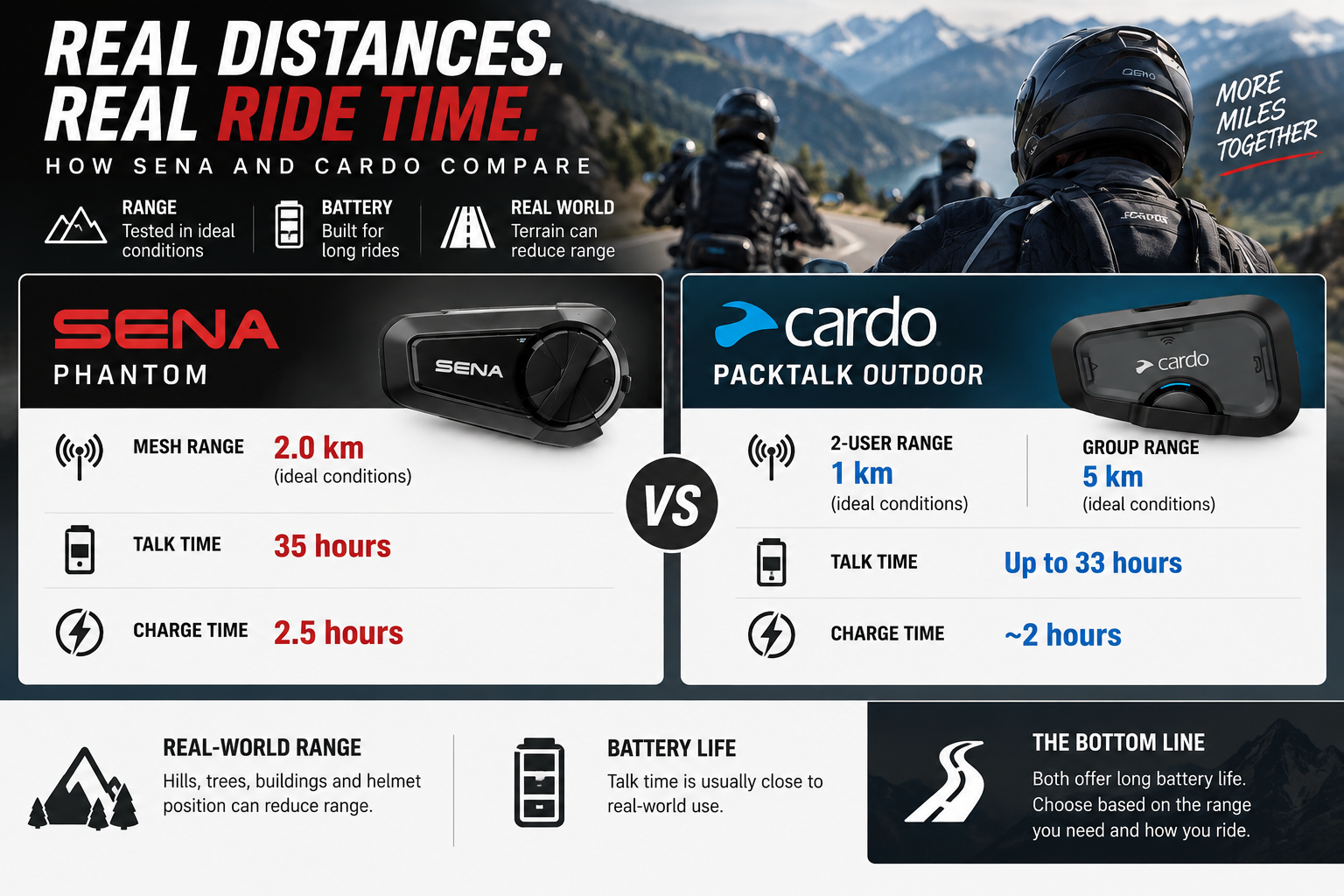
Every spec sheet lists a range number measured in ideal, open-terrain conditions, line of sight, no buildings, no hills, nothing between the two units. The Sena Phantom's listed 2.0km mesh range and the Cardo Packtalk Outdoor's 1km two-user range (extending to 5km across a full group) are both real numbers under those specific conditions, but real-world range drops with terrain, tree cover, and how the helmet itself is positioned relative to the antenna.
Battery life numbers are more reliably close to real-world performance, since talk time doesn't depend on terrain the way range does. The Sena Phantom's claimed 35-hour talk time with a 2.5-hour charge time is a genuinely useful baseline for comparing units: a full day of riding with intercom running rarely comes close to draining a modern unit, but multi-day trips without a charging stop are worth planning around the specific unit's numbers rather than assuming.
Frequently Asked Questions
Which is better, Cardo or Sena?
Neither wins across the board, and the honest answer depends on what you're optimizing for. Sena has the stronger lineup of fully integrated smart helmets if you want communication built in from the factory. Cardo's Dynamic Mesh Communication has a long track record and strong group-mesh performance if you're mounting a standalone unit to a helmet you already own. Both brands make genuinely competitive hardware; the better fit depends on your setup, not a clear winner.
What is the best Bluetooth intercom system for motorcycle helmets?
It depends on your riding group. Solo riders or duos who mostly want calls and music can get by with a simpler standard Bluetooth unit. Larger groups who ride spread out benefit specifically from mesh technology, either Sena's Mesh Intercom or Cardo's DMC, since both handle riders dropping in and out of range far better than a standard Bluetooth chain. If everyone in your group is buying new, picking one brand across the board gets you the full mesh feature set; a mixed-brand group falls back to standard Bluetooth pairing between units.
The Right System Is the One Your Whole Group Can Use
A top-of-the-line mesh unit doesn't do much good if half your riding group is still on basic Bluetooth from a different brand, which is why Perf-Moto carries both Sena and Cardo side by side rather than pushing one as the default answer. The better system is the one that actually matches how your group rides and what everyone else is already using.
Not sure which system fits your group? Ask the team, Monday through Friday, 9 am to 5 pm EST.
Shop Sena and Cardo communication systems and compare standalone units against fully integrated smart helmets.