
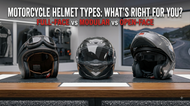
The full-face vs modular helmet decision usually comes down to one honest question: how much convenience are you willing to trade for protection, and how much protection are you willing to trade for convenience? Open-face helmets push that tradeoff even further in the convenience direction. \
None of the three is objectively wrong, but each one is built around a different priority, and knowing exactly what you're gaining and giving up with each makes the decision a lot less confusing than scrolling through reviews hoping one type gets crowned the winner.
This guide breaks down all three, plus one detail almost nobody explains clearly: whether it's actually safe to ride with a modular helmet's chin bar flipped open, which has a real technical answer most buying guides skip entirely. Browse the full helmet lineup as you read to see all three types side by side.
Quick Takeaways
- Full-face wins on protection and aerodynamics, full stop. It's the benchmark every other type is measured against.
- Modular helmets aren't automatically safe to ride with the chin bar open. That depends entirely on a specific certification most riders have never heard of.
- Open-face helmets trade real chin and jaw protection for comfort and visibility. That's a genuine tradeoff, not a minor one.
- Modular helmets run 200 to 300 grams heavier than an equivalent full-face, almost entirely due to the hinge mechanism.
The Three Types of Motorcycle Helmets Compared
Before going deep on each one, here's the short version of how the three types of motorcycle helmets stack up against each other:
- Full-face: complete coverage, chin bar permanently fixed in place, no moving parts, the most protective and aerodynamic option by design.
- Modular: a hinged chin bar that flips up, giving you full-face coverage when closed and open-face-style access when you need it, at the cost of extra weight and mechanical complexity.
- Open-face: no chin bar at all, maximum airflow and peripheral vision, and the least protection of the three, particularly around the chin and jaw.
Full-Face Helmets: Maximum Coverage and Aerodynamics
A full-face helmet's shell is one continuous piece with no hinge, no seam at the chin, and no moving parts, which is exactly why it's both the most protective option and the most aerodynamically efficient. That single-piece shell shape is engineered to manage airflow smoothly at highway speed, reducing the buffeting, lift, and wind noise that a helmet with a seam or gap tends to pick up.
Choosing the right full-face helmet comes down to a few specific things beyond just picking a size off a chart. Shell shape matters for anyone riding at real highway speeds, since a helmet designed for an aggressive, tucked-forward riding position behaves differently in crosswinds than one designed for an upright commuter posture.
Ventilation matters more than people expect, since a fully enclosed shell traps heat that a modular or open-face helmet vents more easily. And weight matters disproportionately on long rides, since even a small difference compounds over hours in the saddle.
The honest tradeoff: some riders genuinely find a full-face helmet claustrophobic, and simple things like a phone call, a sip of water, or talking to someone at a gas stop require removing the whole helmet rather than just flipping up a chin bar. If aerodynamics and weight matter most to you, Perf-Moto's Bell Eliminator Carbon is built around exactly that tradeoff, a full-face, carbon-shell helmet at the lighter end of the spectrum.
For the same retro full-face styling at a more accessible price point, the Bell Eliminator Speedtrack is worth a look.
Modular Helmets: Flip-Up Convenience, With a Catch
A modular helmet's whole appeal is the hinged chin bar: flip it up at a stoplight or gas station without taking the helmet off, then flip it back down and ride with the same coverage as a full-face. That mechanism is also exactly where the tradeoffs come from.
Weight is the most immediate one. The hinge and the reinforced structure around it typically add somewhere around 200 to 300 grams compared to an equivalent full-face helmet, barely noticeable on a short commute, genuinely noticeable on a four-hour ride.
Mechanical complexity is the other real tradeoff: a locking latch has to hold securely under crash loads every single time, which is one more component that has to perform correctly compared to a full-face helmet's single fixed shell.
Perf-Moto's Bell Lithium MIPS OBSP is one modular option worth checking out, pairing the flip-up design with a MIPS rotational-protection liner; confirm its specific open-position certification on the product page before assuming it's rated to ride open.
There's also a certification detail almost no one explains clearly, and it directly answers one of the most common questions about modular helmets.
Can I Ride With My Modular Helmet Open? The P/J Homologation Answer
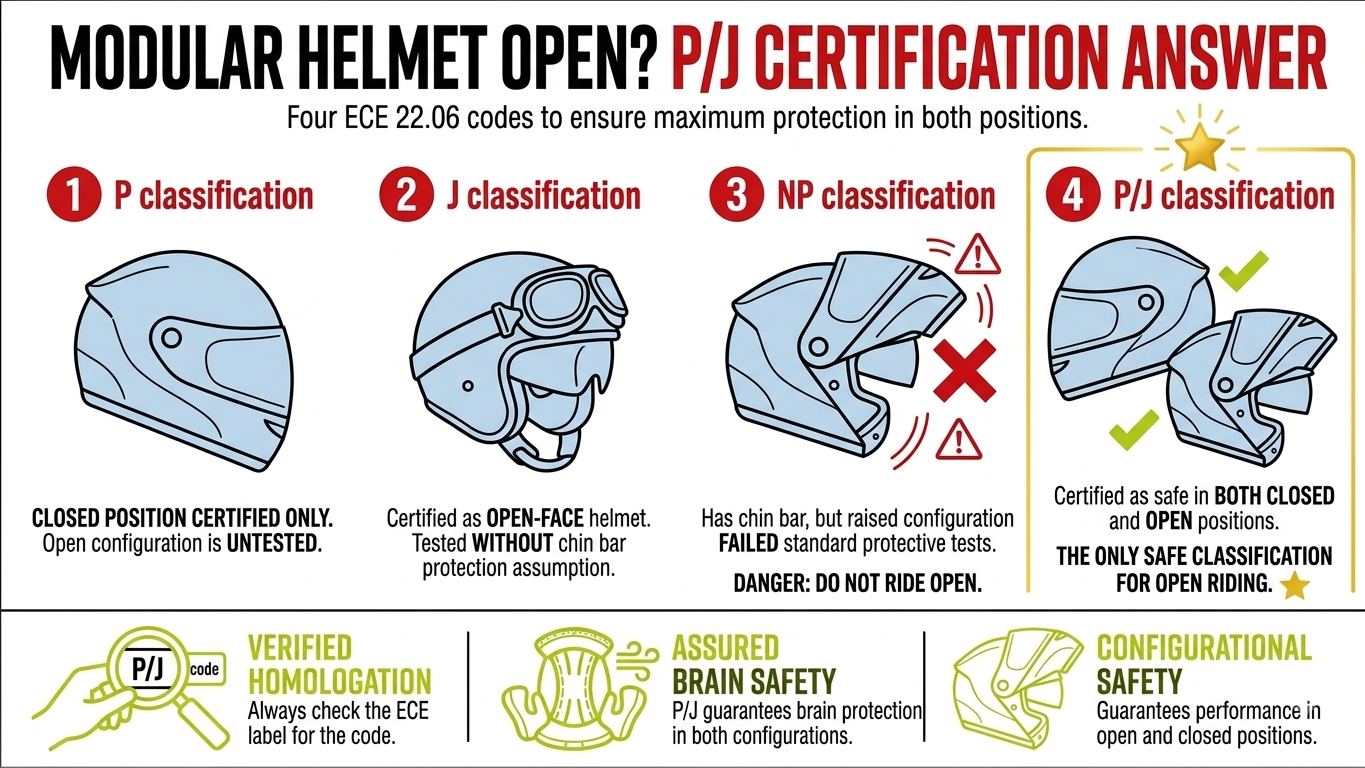
Here's the detail that gets skipped in most helmet buying advice: not every modular helmet is actually certified to be ridden with the chin bar flipped open, and lifting the chin bar on one that isn't doesn't just downgrade you to "open-face level" protection. It puts you in a configuration that's never been tested at all.
Under ECE 22.06, modular helmets receive one of four specific classification codes, according to the United Nations Economic Commission for Europe (UNECE), the regulatory body behind the standard:
- P (Protective): certified for the closed position only. Riding with the chin bar open is outside what's been tested.
- J (Jet): certified as an open-face helmet, meaning it was tested without assuming chin bar protection at all.
- NP (Not Protective when open): has a chin bar, but that chin bar hasn't met the protective standard when raised.
- P/J (Protective/Jet): certified as safe in both the closed and open positions, the only classification that actually confirms it's safe to ride with the chin bar flipped up.
If a modular helmet's certification doesn't specifically say P/J, the safe assumption is that it was only tested closed, and riding with the chin bar open puts you in a genuinely untested state rather than a known, lesser level of protection. This distinction matters enough that it's worth checking before you buy if riding open is something you actually plan to do regularly, not just something you assume the helmet allows because the chin bar physically lifts.
Insurance and safety educators reinforce the same practical guidance: treat a modular helmet like a full-face whenever you're actually riding, and save the open position for stops, according to general motorcycle helmet safety guidance.
Open-Face Helmets: What You're Trading Away
An open-face helmet has no chin bar at all, which is the entire point and also the entire limitation. What you gain is real: maximum airflow, the widest field of peripheral vision of the three types, and a lighter, less bulky feel overall. What you give up is just as real: your chin and jaw have zero structural protection, which matters specifically because facial injuries from chin-first impacts are common enough that every other helmet type in this guide is built specifically to prevent them.
Open-face helmets tend to make the most sense for lower-speed riding, hot climates where ventilation matters more than almost anything else, and cruiser-style riding where the upright position and typical speeds are genuinely different from a sportbike or highway commute. It's a legitimate choice for the right riding style, not an inferior version of a full-face helmet, but going in with clear eyes about what it doesn't cover matters.
Frequently Asked Questions
Should I get a full-face or modular helmet?
If you're commuting, touring, or regularly stopping to talk, eat, or drink without wanting to remove your helmet entirely, a modular helmet's flip-up convenience is worth the small weight penalty. If you're riding aggressively, at consistent highway speeds, or want the most protection and best aerodynamics without any tradeoffs, a full-face helmet is the more straightforward choice. Neither is wrong; they're built for slightly different riding patterns.
Which is better, an open face helmet or a full-face helmet?
Full-face is more protective by every measure that matters in a crash, since it covers the chin and jaw that an open-face helmet leaves completely exposed. Open-face wins on airflow, peripheral vision, and that lighter, more open feel some riders strongly prefer, especially at lower speeds or in hot weather. "Better" depends on whether you're prioritizing protection or comfort and visibility, since they're not really solving the same problem.
What are the disadvantages of modular helmets?
Extra weight (typically 200 to 300 grams more than a comparable full-face helmet), a mechanical hinge and latch that has to perform correctly every time, a price premium over full-face helmets at a similar quality tier, and, unless the specific model carries P/J homologation, no verified certification for riding with the chin bar open.
How do I choose the right full-face helmet?
Start with fit and head shape, the same fundamentals covered in our full sizing guide. Beyond that, match shell shape and aerodynamics to your riding style, since a helmet designed for an aggressive sportbike posture handles differently at speed than one designed for upright commuting. Check ventilation if you ride in hot climates, and don't ignore weight, especially if you're doing multi-hour rides regularly.
What is the 2-2-2 rule for bike helmets?
It's a fit check, not a helmet-type decision, but it applies no matter which of the three types you land on: roughly two finger-widths of clearance above your eyebrows, a two-finger V shape where the straps meet under your ears, and two fingers of room between your chin and the fastened strap. Run this check on whichever type you choose before deciding it's the right fit.
No Wrong Choice, Just the Right One for How You Ride
Full-face, modular, and open-face all solve real problems for real riding styles, which is exactly why Perf-Moto stocks all three rather than pushing one as the universal answer. If a helmet type doesn't end up matching how you actually ride once you've tried it, the site's guaranteed-fitment policy and straightforward exchange process exist specifically so that decision doesn't have to be final on the first guess.
Not sure which type fits your riding style? Ask the team before you order, Monday through Friday, 9 am to 5 pm EST.
Compare full-face, modular, and open-face helmets side by side and filter by type.