

Quick Answers
| Question | Short Answer |
| How many studs? | Light trail: 96. Aggressive trail: 144. Ice and lake: more. |
| What length? | Long enough to stick out 1/4" to 3/8" past the top of the lug. |
| Need carbides? | Yes. More studs means more carbide up front. |
| Single-ply or two-ply track? | Check first. It decides which stud and backer you can use. |
Snowmobile studs give your track the bite it can't get on its own on hardpack, ice, and wind-polished lake surfaces. Studs shorten stopping distance, improve acceleration, and keep the back end from stepping out in corners. Getting them right comes down to three decisions: how many studs, what length, and what goes on the front of the sled to balance them.
This guide covers all three, plus the parts that make a stud job last: backer plates, nuts, and carbide runners. Everything below is available in Perf-Moto's snowmobile traction and wear bar collection.
Step 1: Know Your Track (Single-Ply vs Two-Ply)
Before you buy anything, find out whether your track is single-ply or two-ply. Many modern lightweight performance sleds run single-ply tracks, and the stud you can use depends on it.
Single-ply studs use a larger head to spread the load over a thinner belt. Woody's states that its Grand Master single-ply stud cannot be used in a traditional 2-ply track. Two-ply studs and backers, like Stud Boy's Pro Series double backers built for regular Power Point studs, are designed for the thicker belt.
If you aren't sure which track you have, check your owner's manual or the track manufacturer's spec sheet. You can also call Perf-Moto at (616) 494-0103 before you order.
Step 2: Choose the Right Stud Length
Stud length is the decision riders get wrong most often. Too short, and the stud barely touches the ice. Too long, and you risk tearing the track or hitting the tunnel and heat exchanger.
Stud Length vs Lug Height
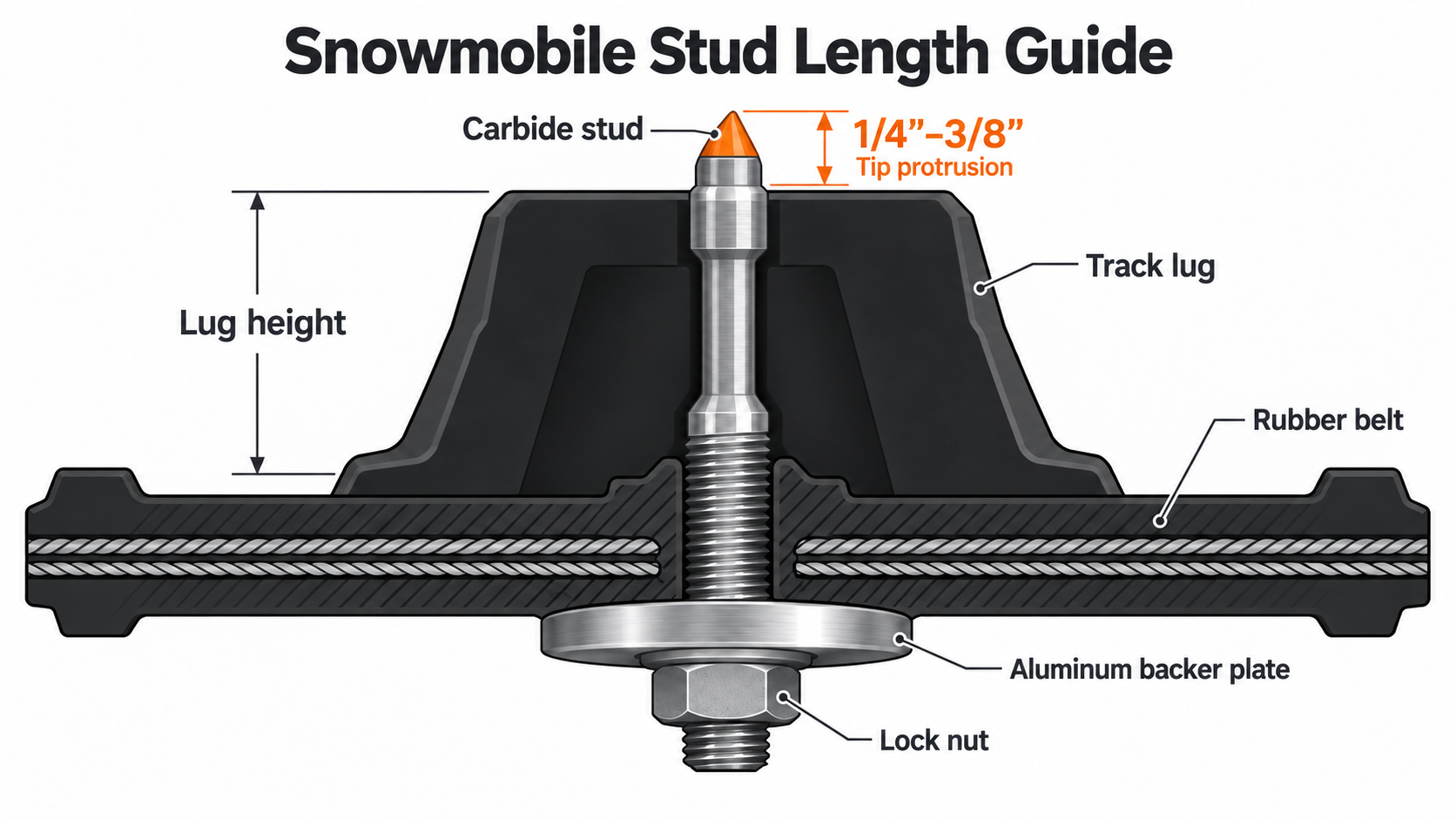
The rule Woody's recommends is simple: the stud tip should protrude 1/4" to 3/8" above the top of the track lug. To get there:
- Measure lug height from the track belt to the top of the lug.
- Account for what sits under the stud. The belt thickness, the backer plate, and the nut all affect how far the tip ends up above the lug.
- Pick the effective length that lands the tip in the 1/4" to 3/8" window.
- Confirm after install. Lay a straightedge across the lugs and measure the exposed tip on a few studs.
Common Stud Lengths
Woody's Grand Master single-ply studs come in several effective lengths, including 1.075", 1.325", 1.450", and 1.575". The 1.325" size is the most common choice for trail riding, which is why it shows up in so many kits. Fast-Trac's Top Gun SP studs are sold in lengths such as 1.175" and 1.375".
Don't buy a length because a riding buddy uses it. Lug heights vary between tracks, so measure your own.
Watch Your Clearance
Longer studs need more room. Woody's notes that proper clearance and tunnel protection are essential with longer stud lengths. A stud that hits the tunnel or heat exchanger at full suspension compression can cause expensive damage. If you're stepping up in length, check clearance with the suspension compressed and consider tunnel protectors.
Step 3: Decide How Many Studs You Need
There's no single right number, but these ranges are a sound starting point for most trail sleds:
|
Riding Style |
Typical Stud Count |
Pattern |
|
Casual trail, mixed snow |
96 |
2 per row |
|
Aggressive trail, hardpack |
144 |
3 per row |
|
Lake riding, glare ice |
144+ |
3 or more per row |
More studs mean more grip on ice, but they also add weight and wear. A 96-stud setup is popular for riders who mostly see groomed trails with occasional icy corners. Move to 144 if you ride hard-packed or icy trails often.
Stud Pattern
How you place studs matters as much as how many. A good stud pattern:
- Staggers studs so no two consecutive rows hit the same line on the ground
- Keeps studs clear of the drive lugs and idler wheel paths
- Places studs evenly across the track width so the sled tracks straight
Most kits include a template or pattern guide. Follow it, and drill clean holes with a proper track hole cutter rather than punching through with whatever is in the garage.
Step 4: Add Carbide Runners to Balance the Studs
Do You Need Carbides With Studs?
Yes. Studs add grip at the rear. Without matching grip up front, the sled pushes straight in corners while the back end keeps driving. That's called understeer, and on ice it means running wide off the trail.
Carbide runners (also called wear bars) add a hard cutting edge to the bottom of each ski so the front can turn with the rear. Fast-Trac gives a clear rule of thumb on its site: 2 studs per row should be paired with 6" of carbide, and 3 or more studs per row with 8" of carbide.
What to Look For in Carbide Runners
- Carbide length: match it to your stud count (see above).
- Carbide angle: 60° carbide is the common trail cut and bites well on hardpack.
- Fitment: runners are ski-specific. Use the vehicle selector on the product page.
One example in Perf-Moto's lineup is the Stud Boy Deuce 4.5" Carbide Runner, a one-piece dual-runner design with 60° cutting carbide and a self-cleaning shape that resists clogging with snow and ice. It fits a range of Polaris models and is sold separately. Woody's carbide wear-bar runners, including the Trail Blazer IV line, are also available in the traction and wear bars category, so filter by your sled.
Best Snowmobile Studs and Traction Parts for 2026
Woody's Grand Master 1.325" Carbide Studs: Best Single-Ply Trail Stud
Woody's describes the Grand Master as the most popular single-ply track stud for trail riding. It's through-hardened carbon steel with a 60° carbide insert, a 1.2" head with anti-rotation lines, and 5/16" threads.
The easiest way to buy it is as the Woody's 1.325" Grand Master Studs/Nuts/Backers Kit (90 pack). The kit includes studs, Short Big Nuts, and Round Grand Digger plates, so everything matches. Woody's also sells Grand Master studs in smaller packs, including 12-packs for repairs and top-ups and 84-packs for full installs, which you can find in the snowmobile traction category.
Best for: Trail riders on single-ply tracks who want a proven, complete kit.
Fast-Trac Top Gun SP Studs: Best Lightweight Single-Ply Option
Fast-Trac's Top Gun SP studs are built for single-ply tracks. They use industrial-grade stainless steel with a silver-soldered mining-grade carbide insert, and a light, thin-profile head that reduces idler wheel wear and helps track rotation. Stainless steel nuts are included on most lengths.
- Fast-Trac Top Gun SP 1.175" Studs, 84 Pack
- Fast-Trac Top Gun SP 1.375" Studs, 24 Pack
Best for: Riders who want stainless construction and lower rotating weight.
Stud Boy Pro Series SuperLite Double Backer Plates: Best Backers for Two-Ply Tracks
Backer plates spread the stud's load across the inside of the belt so the stud can't pull through. The Stud Boy Pro Series SuperLite Double Backers (48 pack) have the support nut molded directly into the backer. They're designed for regular Power Point studs in 2-ply tracks, with a 0.750" height for studs 1.375" and longer, and a 5/16"-24 self-tapping thread.
Best for: Two-ply track owners who want strong, lightweight stud support.
Installation Tips That Save Tracks
- Never skip backer plates. Studs without proper backers are the main cause of torn tracks.
- Torque nuts to spec and recheck after the first ride. Loose studs can spin, wear the hole, and pull out.
- Use the right nuts. Some lengths call for specific nuts. Woody's matches its Big Nuts to stud length in its packs.
- Inspect regularly. Look for missing studs, dull carbide tips, and cracks around the holes.
- Keep spare studs on hand. A 12-pack covers the occasional lost stud without breaking up a full set.
Frequently Asked Questions
How many studs do I need for my snowmobile?
Most trail riders start with 96 studs (2 per row). Riders who see a lot of hardpack or ice usually go to 144 (3 per row). Lake and glare-ice riding can call for more. Whatever you choose, match your carbide runner length to your stud count.
What length snowmobile studs do I need?
Choose a stud length that leaves the tip 1/4" to 3/8" above the top of the track lug after installation. Measure your lug height, account for the belt, backer, and nut, then pick the effective length that lands in that range. Check clearance to the tunnel and heat exchanger before riding.
Do I need carbides with studs?
Yes. Studs increase rear traction, so you need more front grip to steer. A common guideline is 6" of carbide for 2 studs per row and 8" of carbide for 3 or more studs per row.
Can I use single-ply studs in a two-ply track?
Not always. Woody's Grand Master single-ply studs cannot be used in traditional two-ply tracks. Check your track type and the stud's listed track compatibility before you buy.
Are Woody's studs better than Fast-Trac or Stud Boy?
All three are established traction brands, and each has strong options. Woody's Grand Master is a popular single-ply trail choice and is easy to buy as a complete kit. Fast-Trac's Top Gun SP uses stainless steel and a light head. Stud Boy is known for its backer plates and carbide runners. The right pick depends on your track type, stud length, and riding style.
Shop Snowmobile Traction at Perf-Moto
Studs, backers, nuts, and carbides work as a system. Get the length right, match the count to your riding, and balance the front with enough carbide, and your sled will stop, go, and turn with confidence on ice.
Browse Woody's, Fast-Trac, and Stud Boy in Perf-Moto's snowmobile traction and wear bar collection, with free shipping on all USA orders. Gearing up for the season too? See Perf-Moto's snowmobile riding gear.