
If you're wondering what gear I need for motocross, the answer looks different from street riding gear in almost every category. Dirt riding throws different hazards at you: roost kicked up by other riders' tires, mud and dust in your eyes, constant impact through your boots from rough terrain, and a riding position where you're standing and shifting your weight instead of sitting still. This motocross gear guide covers the full setup, piece by piece, so you're not just wearing street gear on a dirt bike and hoping it holds up.
One quick note before the checklist: gear built for pavement and gear built for dirt solve different problems, so even if you already ride on the street, plan on a separate kit rather than mixing the two. You can browse Perf-Moto's MX and off-road apparel filtered specifically for dirt riding as you go through this guide.
Quick Takeaways
- The full checklist covers seven pieces: helmet, goggles, jersey and pants (the "MX kit"), gloves, boots, and body armor.
- Goggles need tear-offs or roll-offs, not just UV protection like street sunglasses. Mud and dust are the enemy, not sun glare.
- Chest protectors and roost guards defend against more than falls. Rocks and dirt thrown up by other riders' rear tires are a real, constant hazard unique to off-road riding.
- Boots are taller and more rigid than street boots on purpose, built for ankle support against nonstop footpeg and ground impact.
- Beginners don't need the priciest kit on day one. Helmet, boots, and goggles first; everything else can be mid-tier while you're learning.
What Gear Do I Need for Motocross? The Complete Checklist
- Helmet. MX-specific, not a street helmet. Look for more chin bar ventilation and a design built around an upright, standing riding position rather than a tucked-in street posture.
- Goggles. Sit outside the helmet's eyeport, sealed against dust and mud, not just tinted for sun glare.
- Jersey and pants. Often called the "MX kit," sold as a matching set or mixed separately.
- Gloves. Lighter and more flexible than street gloves, prioritizing grip and lever feel over impact armor.
- Boots. Taller, more rigid, with replaceable buckles and a sole built for footpeg grip.
- Chest protector or roost guard. Deflects rocks and debris as much as it cushions impact.
- Knee guards or knee braces. Ranges from soft knee sleeves to hinged braces depending on how much support you want.
Neck braces are common but genuinely debated among riders and racers; more on that below.
The MX Kit: Jersey and Pants
Motocross jerseys and pants are built for a completely different job than street apparel. They're lightweight and highly breathable, since you're working hard physically and generating far more body heat standing and shifting your weight than sitting on a cruiser. Pants come pre-curved at the knee to match a bent-knee riding stance, and the fit tends to run looser overall than street riding gear, trading a snug aerodynamic cut for freedom of movement.
Most riders buy jersey and pants as a matching set from one line within a brand, mainly because the cut and stretch panels are designed to work together, though mixing pieces across brands is common too if fit matters more to you than a matching look. Check out motocross jerseys and MX pants to see the range of cuts and price points.
Goggles: Protecting Against Roost, Mud, and Dust
"Roost" is the spray of dirt, mud, and small rocks kicked up by the rider ahead of you, and it's a genuinely unique hazard to off-road riding that street gear was never designed around. A regular pair of sunglasses does nothing against a face full of roost at speed. MX goggles solve this with a sealed foam gasket against the face and one of two clearing systems:
- Tear-offs. Thin plastic film layers stacked on the lens that you rip off mid-ride the moment visibility drops, revealing a clean layer underneath.
- Roll-offs. A canister-based system on each side of the goggle that rolls a continuous strip of film across the lens with a pull cord, useful for longer motos where you'd otherwise run out of tear-off layers.
Lens tint matters too: clear lenses for overcast tracks or night riding, tinted or mirrored lenses for bright sun, and some riders carry a spare lens or a second pair entirely for changing conditions over a race day. Browse MX goggles and eyewear to compare tear-off compatibility and lens options.
Body Armor: Chest Protectors, Roost Guards, and Neck Braces
Chest protection on a dirt bike does two jobs at once: cushioning impact if you go down, and deflecting the same roost your goggles are protecting your eyes from, since a rock or clump of dirt at speed can hurt just as much hitting your ribs as your face. Lighter roost-focused protectors prioritize ventilation and range of motion; heavier body armor adds more coverage and is more common among trail and enduro riders who spend longer stretches in the saddle away from a track's more forgiving layout.
Neck braces are where opinions genuinely split. Some riders treat them as essential, especially after high-profile injuries brought attention to neck and spinal protection in the sport; others find them restrictive and prefer to rely on neck-strengthening exercises and riding within their limits instead. There's no universal consensus here, so if you're on the fence, it's worth trying one on and riding a session with it before committing either way.
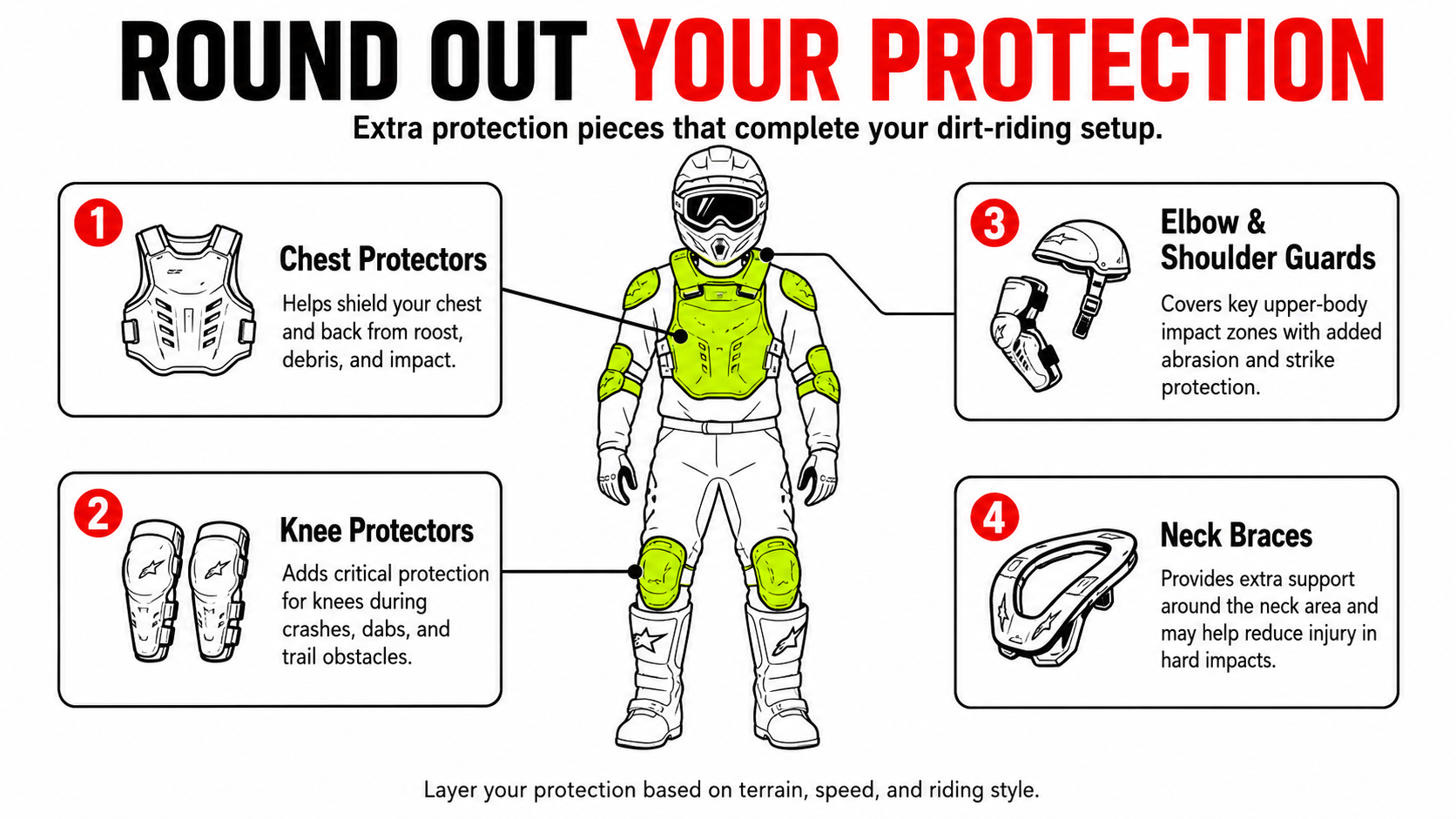
Round out your protection with chest protectors, knee protectors, elbow and shoulder guards, and neck braces if you decide to add one.
Motocross Boots: Why They're Built Different From Street Boots
Motocross boots are taller, stiffer, and considerably more armored than anything built for street riding. That rigidity isn't an accident: your ankles absorb constant, repeated impact from rough terrain and hard landings in a way street riding simply doesn't demand. Most MX boots use replaceable buckle systems rather than laces or zippers, since the whole boot is designed to be serviceable after the abuse a season of riding puts on it, and the sole is shaped specifically to grip a footpeg rather than to walk comfortably.
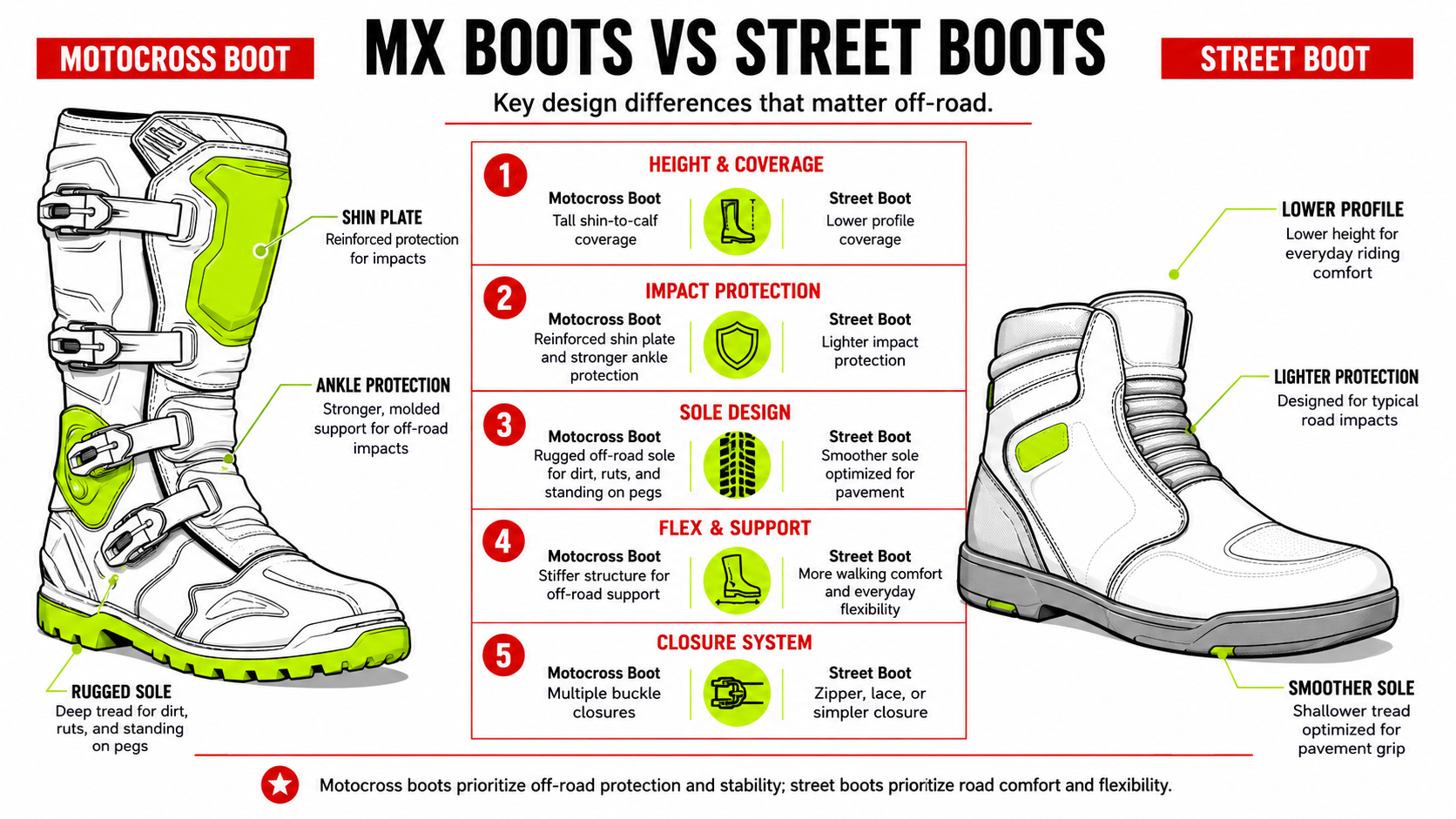
If you already read our guide to street riding boots, treat this as a completely separate purchase. The overlap between the two is minimal. Shop the full range of motocross boots built specifically for off-road impact and grip.
Building a Beginner Dirt Bike Gear List on a Budget
You don't need every piece at once, and you don't need the most expensive version of anything to start riding safely. A sensible order to build out a beginner dirt bike gear list:
- Helmet and boots first. These protect the two areas most likely to end a riding season if injured: your head and your ankles.
- Goggles next. Riding without eye protection off-road isn't really an option once you've taken one face full of roost.
- Jersey, pants, and gloves after that. Mid-tier options here perform almost as well as premium lines for a beginner still learning the sport.
- Chest protector and knee protection as budget allows. Not optional forever, but reasonable to phase in over your first season if money is tight upfront.
Browse MX and off-road apparel to build out a kit at whatever pace your budget allows.
Frequently Asked Questions
What gear do dirt bikers wear?
The short list: helmet, goggles, jersey, pants, gloves, boots, and some form of chest or body armor. Most riders add a neck brace and knee protection on top of that baseline, though those two are more personal-preference items than universal requirements.
What MX gear is best for beginners?
Beginners are usually best served by mid-tier gear that fits well and offers room to grow, rather than the most expensive race-level lines. Fit and comfort matter more than performance features you won't notice yet, since you're not pushing gear to its limits early on. Youth riders in particular should prioritize adjustable or growth-room sizing over locking into a single size for the season.
Is 70 mph fast for a dirt bike?
Yes, genuinely fast, especially for a motocross bike specifically. MX bikes are geared for torque, acceleration, and handling jumps and turns, not sustained top speed, and most motocross tracks don't have straights long enough to reach anywhere near that speed regardless. Enduro and dual-sport bikes ridden on open trails or roads can realistically reach 70 mph on the right gearing, but that's a different riding context than a motocross track.
Riding Since '97: Gear That Actually Fits the Way You Ride
Perf-Moto started as a brick-and-mortar motorsports shop in Holland, Michigan back in 1997, before moving fully online. That background shows up in how the site is built: free domestic shipping, a guaranteed-fitment policy, and a lowest-price guarantee, because gear that doesn't fit or ship on time doesn't help anyone ride. Perf-Moto carries motocross and off-road gear across dozens of brands, so recommendations here are about what actually protects and performs, not about pushing one label over another.
Questions about sizing, fitment, or an order? Contact Perf-Moto's team. They're real humans, Monday through Friday, 9 am to 5 pm EST.
Ready to gear up? Shop the full motocross and off-road lineup at Perf-Moto and filter by jersey, pants, boots, or protection.