
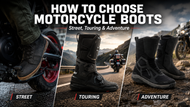
Boots are the piece of gear riders skip fixing the longest, mostly because a bad pair doesn't announce itself the way a helmet that doesn't fit does. You just kind of get used to sneakers with zero ankle support, or a boot that's technically a "riding boot" but was actually built for a completely different kind of riding than what you're doing.
So what boots should I wear for motorcycle riding actually depends on one honest question first: are you commuting on pavement, touring long distances in changing weather, or genuinely riding off-road some of the time? The right answer changes a lot depending on which one describes you.
This guide breaks down street, touring, and adventure boots separately, plus what the certification label inside actually means. Browse Perf-Moto's full boot lineup as you read through what fits your riding.
Quick Takeaways
- Street, touring, and adventure boots solve different problems. A boot built for one can work for another, but usually with a real tradeoff attached.
- EN 13634 is the actual certification standard for motorcycle boots, testing abrasion resistance, impact protection, and transverse rigidity, not just marketing language on the box.
- A shifter pad and reinforced toe box matter more than they sound like they would. Repeated shifting wears through an unprotected boot faster than most riders expect.
- Waterproof membrane brand names differ, but the job is the same. Gore-Tex, HiPora, SinAqua, and similar proprietary membranes are all solving the same waterproof-and-breathable problem.
- Adventure boots can work fine on the street, just heavier and stiffer than a dedicated street boot, in exchange for genuine off-road capability when you actually need it.
Best Motorcycle Boots for Street Riding: Sport and Commuter Styles
Street and sport boots prioritize a lower profile, more flexibility for gear shifting and quick stops, and enough protection to matter in a fall without turning every ride into a workout for your calves. Perf-Moto's RST S-1 CE boot is a solid entry point here, with a removable toe bumper, 360-degree heel cup, and a waterproof Sinaqua membrane, built specifically as an accessible sport boot rather than a track-only piece.
If you want something closer to a genuine racing-look sport boot, the Dainese Nexus 3 In & Out is worth a look. It's built to be worn two ways, with the shin guard removed for wearing under riding pants, or fully assembled over them for track days, and it uses an anti-twist system at the ankle alongside a waterproof D-WP membrane so you're not choosing between protection and weatherproofing.
Are Adventure Boots Good for Street Riding? Here's the Real Tradeoff
Short answer: yes, they work fine, but there's a real tradeoff to understand before you buy one as your only pair. Adventure boots are built taller and stiffer than street boots, with more ankle and shin coverage, because they're designed to handle standing on pegs over rough terrain, not just sitting in a seat on pavement. That extra structure adds weight and reduces the flexibility you'd get from a dedicated street boot, which matters more on a daily commute than it does on an occasional weekend ride.
Where adventure boots genuinely earn their keep on the street is versatility. Many, like the RST Adventure-X, use a walking-boot-style sole specifically so you're not stuck wobbling around a gas station in a boot built only for footpegs. If you split your riding between pavement and dirt roads even occasionally, that tradeoff usually makes sense. If you're strictly a pavement commuter, a dedicated street boot will likely feel noticeably lighter and less bulky for the same daily ride.
Best Motorcycle Touring Boots: Built for All-Day Comfort and Weather
Touring boots are the middle ground, built to handle hours in the saddle across changing weather without the extra bulk of a full adventure boot. Perf-Moto's Tourmaster Trailblazer leans into that comfort priority with a HiPora 3-layer waterproof membrane, a molded heel cup, and flex panels specifically added for range of motion on longer rides where a stiffer boot starts to feel like a liability by hour six.
If you want a bit more height and coverage while staying in touring territory rather than crossing fully into adventure-boot bulk, the RST Adventure-X Mid splits that difference, offering the same twin-buckle closure and waterproof membrane as its taller sibling in a shorter, lighter package.
Adventure Boots: Off-Road Capability Without Losing Street Manners
For riders who genuinely spend real time off pavement, dedicated adventure boots go further than the touring-adjacent options above. Perf-Moto's Noru Hakken leather boots are built specifically around that use case, with a gaiter-style top opening that keeps dust, water, and debris out the way a zippered or buckled street boot simply can't, MX-style dual buckles for security on rough terrain, and a waterproof Aqua-Barrier membrane under genuinely abrasion-resistant cowhide leather.
These are certified to the same EN 13634 standard covered below, but built with more aggressive terrain in mind, taller shafts, more reinforcement, and a sole designed to grip loose dirt and rock rather than just pavement.
Ankle Protection and Certification: What EN 13634 Actually Requires
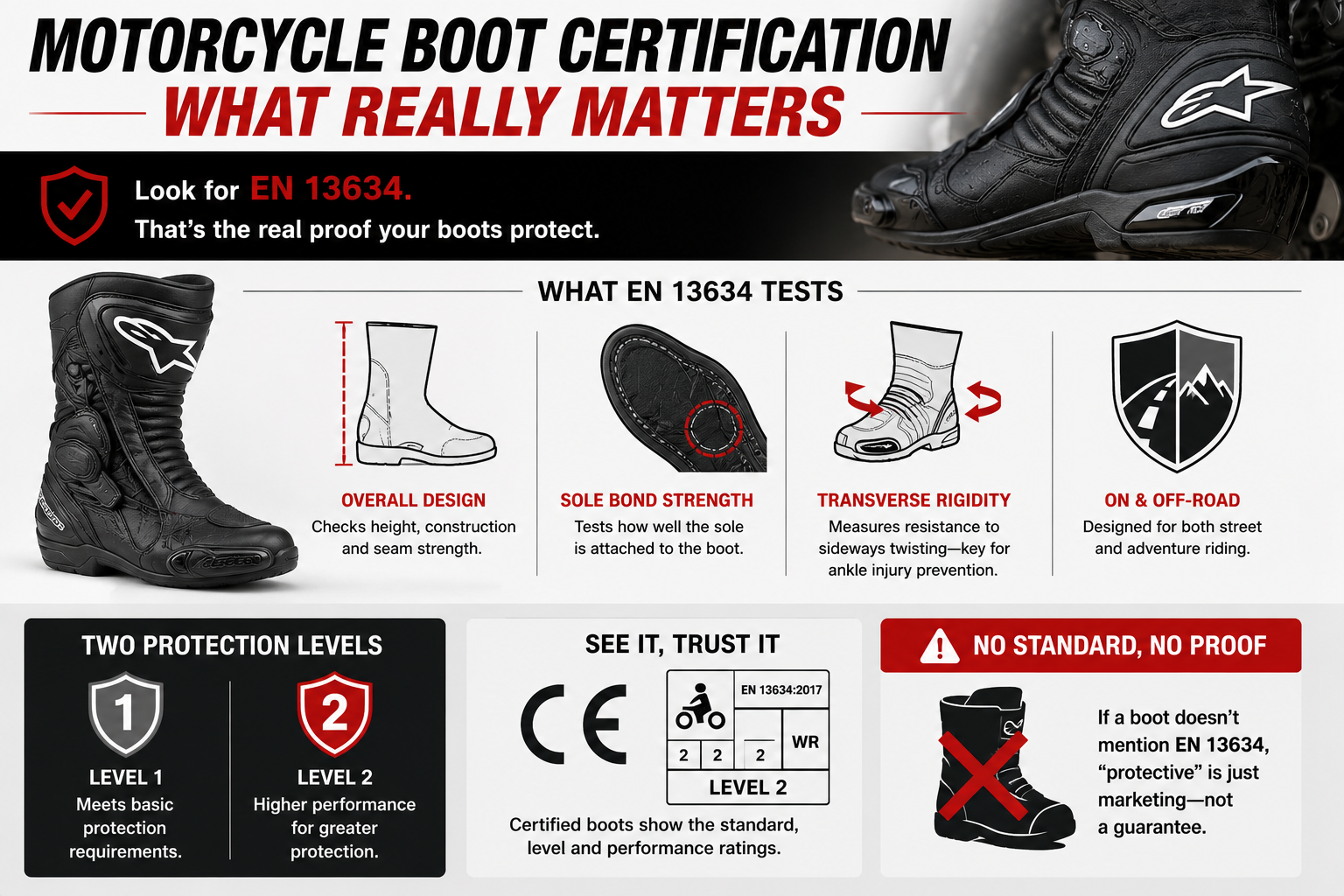
The certification you actually want to look for on a motorcycle boot is EN 13634, not a vague "protective" claim on the box. According to SATRA, a testing lab directly involved with this standard, EN 13634 evaluates the boot's overall design (upper height, seam construction), the bond strength between the upper and outsole, and specifically tests transverse rigidity, essentially how well the boot resists twisting sideways under load, which is exactly the motion that causes a lot of real ankle injuries in a crash or even just a bad footing moment off the bike.
The official standard documentation, published by the European Committee for Standardization, confirms it applies specifically to footwear for both on-road and off-road motorcycle riding, splitting boots into two protection levels similar in spirit to the armor and glove standards covered elsewhere: Level 1 for basic protection, Level 2 for higher performance. If a boot doesn't reference this specific standard anywhere, treat "protective" as a description, not a verified claim.
Sole Grip and Shifter Pads: The Details That Matter Mid-Ride
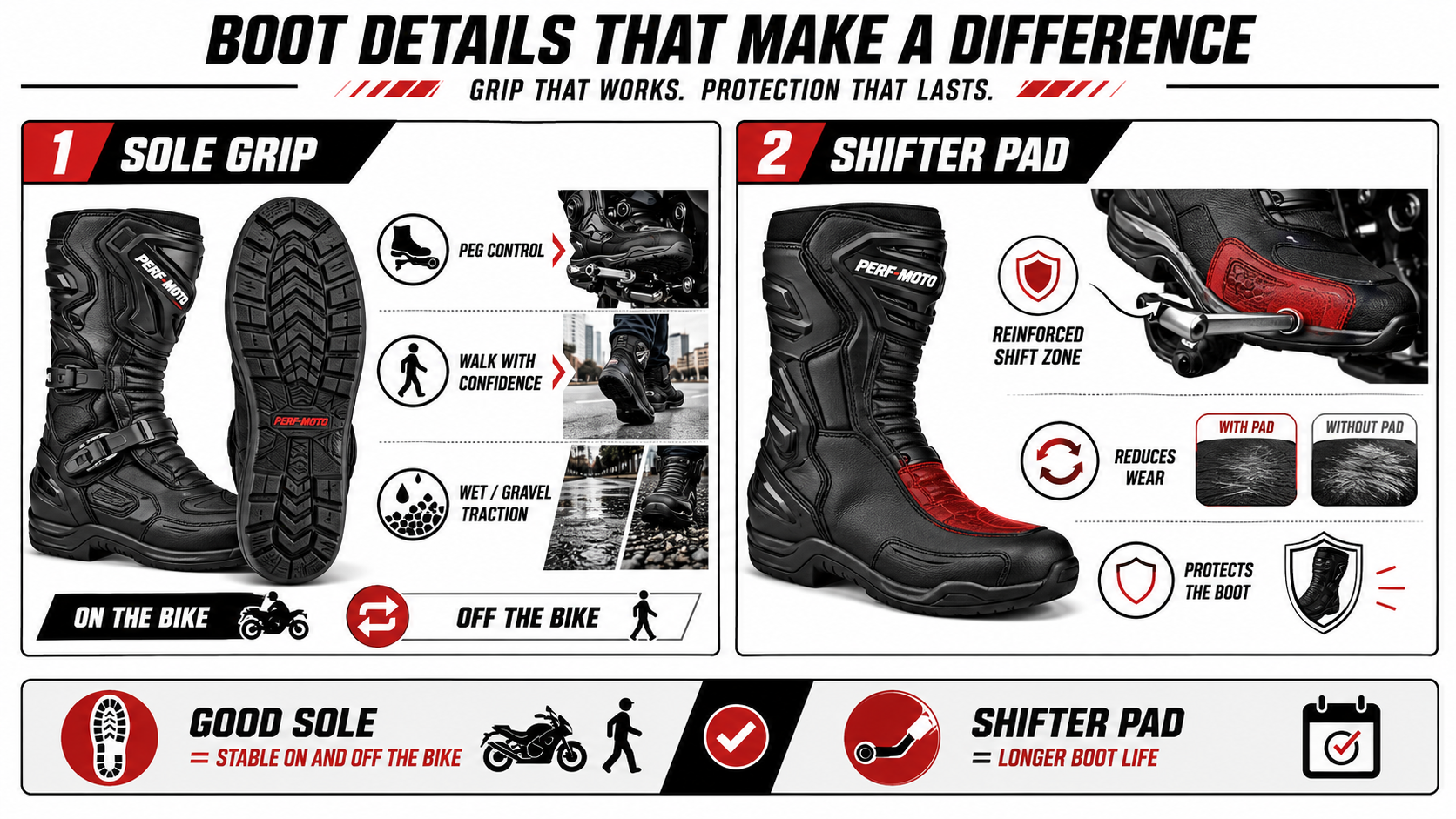
A good motorcycle boot sole needs to grip two very different surfaces well: the footpeg itself, and whatever you're standing on when you're off the bike, wet pavement, gravel, or a gas station floor. Soles built purely for peg grip can feel genuinely unstable walking around off the bike, which is exactly why boots like the Adventure-X above specifically call out a walking-boot-style sole as a feature, not an afterthought.
Shifter pads (sometimes called shift guards) are the reinforced patch on the left boot's inner edge that takes the repeated wear of shifting gears. Without one, that exact spot wears through faster than the rest of the boot, which is why even entry-level street boots like the RST S-1 build in dedicated gearshift reinforcement rather than treating it as a premium-only feature.
Waterproofing: Membrane Type Matters More Than Brand Name
You'll see a handful of different proprietary names on waterproof membranes: HiPora, SinAqua, Aqua-Barrier, D-WP, or straight Gore-Tex on something like the Gaerne G.Xenon.
They're largely doing the same job: blocking water from getting in while still letting sweat and heat escape from inside the boot. None of these names is inherently superior to the others in a way that should drive your buying decision on its own; what actually matters is whether the specific boot's membrane is genuinely sealed at the seams and how it performs in the conditions you actually ride in, not which name is printed on the tag.
Frequently Asked Questions
How do I choose a motorcycle boot?
Start with how you actually ride: pavement-only commuting points toward a street or sport boot, long-distance riding in mixed weather points toward a touring boot, and any real off-road riding points toward a dedicated adventure boot. From there, confirm EN 13634 certification, check for a reinforced shifter pad if you ride a manual, and prioritize a genuinely waterproof membrane if you ride through anything other than dry, mild weather.
What are the top 5 motorcycle boot brands?
We're not going to hand you a ranked list of five names, since a real ranking needs comparative testing data we don't have in front of us, and different brands specialize in genuinely different categories anyway. Some brands lean hardest into race-focused sport boots, others into long-haul touring comfort, others into serious off-road adventure capability. The more useful move is matching the specific boot's certification level and category to your actual riding style rather than chasing a brand name across categories it might not specialize in.
Boots Built for Where You Actually Ride, Not Just How You Look Doing It
Street, touring, and adventure boots aren't marketing categories; they reflect genuinely different demands on your feet and ankles, which is why Perf-Moto stocks all three rather than treating one as the default. Getting this one right matters more than people expect, since boots are worn every single ride, not just the long ones.
Not sure which category actually fits how you ride? Ask the team, Monday through Friday, 9 am to 5 pm EST.
Shop street, touring, and adventure boots and filter by certification level and riding style.