
How to choose a motorcycle helmet is a question worth taking seriously, because the stakes are real. Picking the wrong one costs you two ways: it's uncomfortable enough that you stop wearing it correctly, or it wasn't actually built to protect your head in a crash.
Neither one is theoretical. NHTSA's own crash-data research puts the number plainly: a properly worn, certified helmet reduces your risk of dying in a motorcycle crash by about 37 percent. That's the single biggest safety decision you'll make as a rider, and it has almost nothing to do with how much the helmet costs or how good it looks on the shelf.
That decision comes down to four things, checked in this order: fit, safety certification, helmet type, then extras like shell material, weight, and ventilation. Get the first two right, and you've already captured most of the real protection difference between helmets.
Everything after that is about comfort and how long you can stand wearing it. Skip straight to features or brand name, and it's easy to end up with a helmet that looks great in photos and does a mediocre job of actually staying on your head in a crash.
This helmet buying guide walks through each of those four factors in order, with the specifics you actually need: how to check fit yourself, what DOT, ECE 22.06, and Snell M2025 labels really mean, and which helmet type fits which kind of riding. By the time you're done, you'll know exactly what to look for before you shop motorcycle helmets, instead of guessing based on price or paint job.
Quick Takeaways
- Fit beats brand. A mid-tier helmet that fits perfectly protects you better than a premium one that's loose.
- Look for DOT at minimum. ECE 22.06 or Snell M2025 add independently-tested protection DOT alone doesn't cover.
- Full-face helmets protect the most. Modular and open-face trade some protection for convenience.
- Heavier isn't safer. Modern shells balance weight against impact protection, and neck fatigue is a real problem on long rides.
- Use the 2-2-2 rule to sanity-check fit before you ever swing a leg over the bike.
Start With Fit, Not Brand
Every certification test in this guide assumes the helmet is actually sitting where it's supposed to. A DOT- or Snell-rated helmet that's a size too big won't perform anywhere close to its rating, because it can shift or rotate on impact before the shell ever gets to do its job.
Start with a soft tape measure around your head, about an inch above your eyebrows, and check that number against the specific brand's size chart. Sizing is not standardized across manufacturers, so a medium in one brand can fit like a small in another. Head shape matters too: most brands describe fits as intermediate oval, round oval, or long oval, and matching that shape matters more than matching the size label.
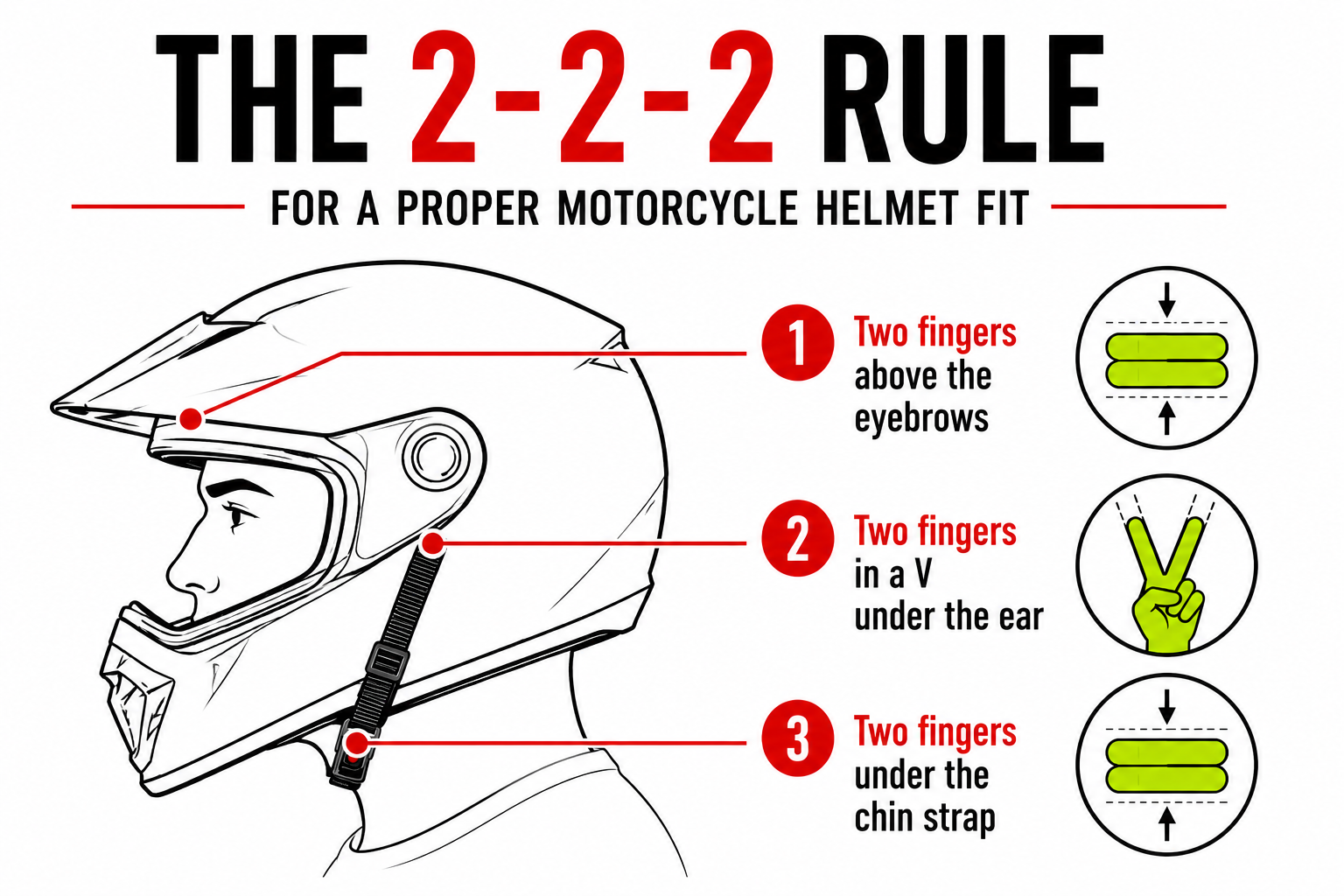
Once it's on, run the 2-2-2 check:
- Two fingers above the eyebrows. The front edge of the helmet should sit about two finger-widths above your brow line, low enough to actually cover your forehead.
- Two fingers in a V under each ear. That's roughly where the straps should meet the sides of your head.
- Two fingers under the fastened chin strap. Snug enough that it won't slide, loose enough that it doesn't choke.
Retention system: this is the technical name for the chin strap and buckle together, the part that keeps the helmet attached to your head during the actual crash, not just before one. If the retention system fails, nothing else the helmet does matters.
Understand Helmet Certification: DOT vs. ECE 22.06 vs. Snell M2025
A helmet's rating tells you who tested it and how hard. Here's how the three standards you'll actually see on a label compare:
|
Standard |
Set By |
How It's Tested |
Required in US? |
|
DOT (FMVSS 218) |
U.S. NHTSA |
Manufacturer self-certifies; NHTSA spot-checks after sale |
Yes |
|
ECE 22.06 |
UN Economic Commission for Europe |
Independently tested; adds rotational-impact testing at up to 18 points |
No, but globally accepted |
|
Snell M2025 |
Snell Memorial Foundation (nonprofit) |
Independently tested; voluntary, higher-energy impact standard |
No, voluntary |
DOT is the legal U.S. minimum, and it works on an honor system: manufacturers self-certify, and the National Highway Traffic Safety Administration audits after the fact rather than testing every helmet before it ships.
You can read how that certification and labeling process actually works directly from NHTSA.
ECE 22.06 and Snell M2025 both add independent lab testing on top of that baseline. ECE 22.06 specifically added rotational-impact testing in its most recent update. A helmet can pass a straight-on impact test but still transfer dangerous rotational force to the brain, which is what that test is designed to catch. Snell M2025 is a voluntary standard run by a nonprofit lab, and it's known for testing at higher energy levels than either DOT or ECE requires.
The Snell Memorial Foundation publishes its full testing methodology and a certified product list, so you can verify a specific helmet model rather than just trusting the sticker.
None of these standards makes the other two obsolete; they test different things. A helmet carrying DOT plus one independent rating (ECE 22.06 or Snell) is a reasonable bar to set for yourself.
Full-Face vs. Modular vs. Open-Face: Motorcycle Helmet Types Compared
- Full-face: the most coverage and the most protection, full stop. No loose ends, no exposed chin or jaw. Best default choice for commuting, touring, or anything at highway speed.
- Modular (flip-up chin bar): full-face-level coverage when it's locked down, with the convenience of flipping the chin bar up at a gas stop without removing the whole helmet. The tradeoff is a bit more weight and a hinge that adds a point of mechanical complexity. Reputable modular helmets test the chin-bar latch separately for exactly this reason.
- Open-face/half helmet: the least protection of the three: no chin or jaw coverage at all, traded for maximum airflow and visibility. Common on cruisers, but worth going in with eyes open about what it doesn't cover.
If you want full-face protection with modular convenience, Perf-Moto's Bell Lithium MIPS OBSP pairs that flip-up design with MIPS, a low-friction liner layer built specifically to reduce rotational force transfer in an angled impact.
Shell Material and Weight: Why They Matter
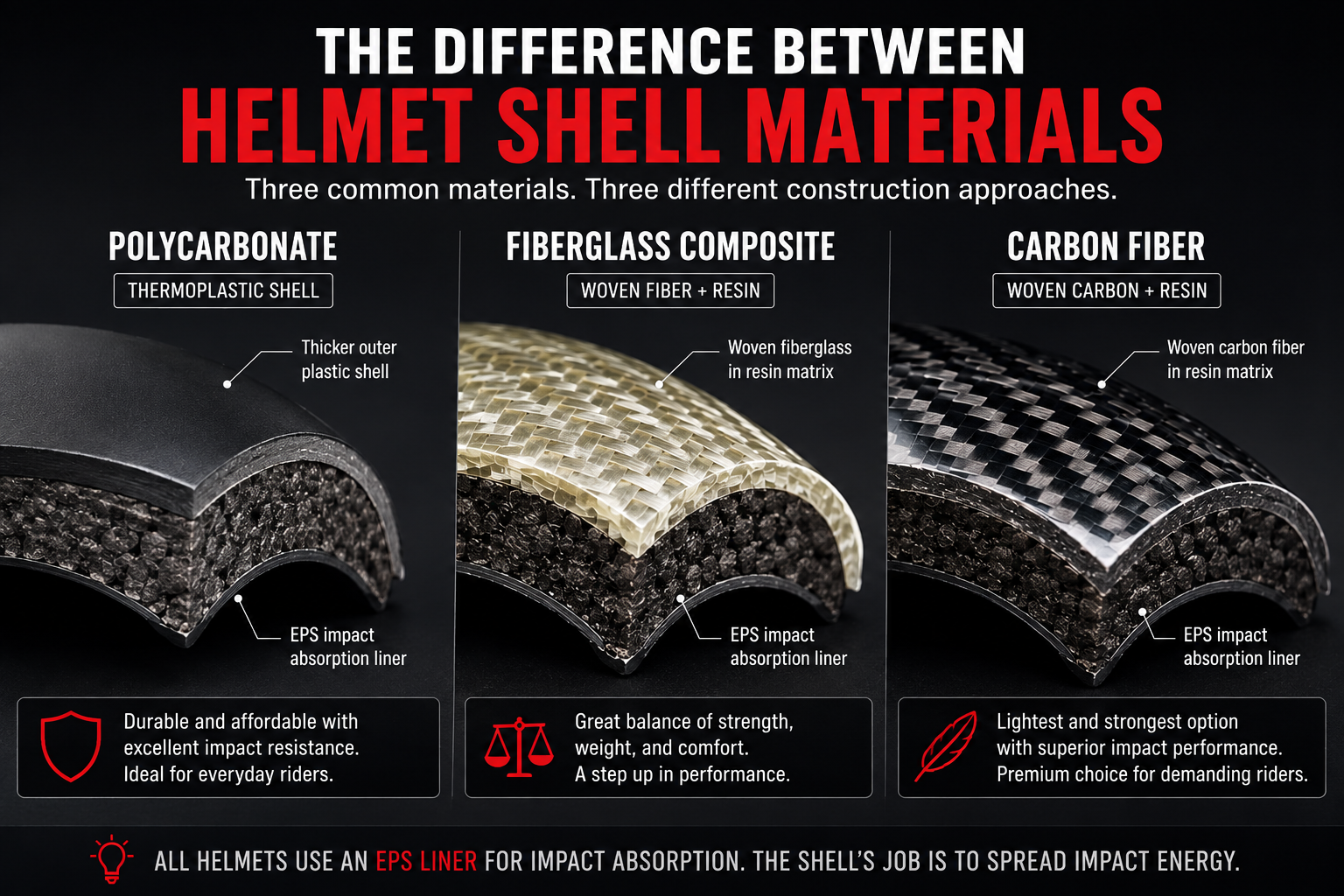
Shell material drives both weight and price, and the tradeoff is pretty linear:
- Polycarbonate: the most affordable option, slightly heavier, and genuinely durable. Most budget and mid-range helmets use it.
- Fiberglass composite: lighter than polycarbonate at a similar or moderately higher price point, common in mid-to-upper-tier helmets.
- Carbon fiber: the lightest option by a meaningful margin, with the best strength-to-weight ratio and the highest price tag.
Weight matters more than people expect on anything longer than a short commute. A couple hundred extra grams doesn't sound like much sitting on a shelf, but it adds up as neck fatigue over a three-hour ride, especially at highway speed where wind load adds resistance every time you turn your head to check a mirror.
For riders who feel that fatigue on longer rides, Perf-Moto's Bell Eliminator Carbon is worth a look: a full-face, carbon-shell helmet built around that lighter-weight tradeoff. If carbon fiber is outside your budget, the Bell Eliminator Speedtrack gives you the same full-face retro styling on a more affordable shell.
Ventilation and Comfort for Long Rides
Ventilation is easy to ignore in a store that's climate-controlled and impossible to ignore at a stoplight in July. Look for adjustable intake and exhaust vents (not just decorative shell vents that don't actually open), and check whether the cheek pads and liner are removable and washable. You will eventually want to wash them, and helmets that don't allow it get retired early for reasons that have nothing to do with safety.
Padding also compresses slightly over the first several weeks of wear. A helmet that feels snug (not loose, not painfully tight) on day one is exactly where you want to start.
Best Motorcycle Helmets by Budget
"Best" depends heavily on what you ride and how often, but a few principles hold across every price tier:
- Entry tier: prioritize a certified full-face helmet over any feature upgrade. Certification and fit matter more at this price point than shell material.
- Mid tier: this is where fiberglass shells, better ventilation systems, and modular options start showing up. It's a good tier to shop in if you ride several times a week.
- Premium tier: carbon-fiber shells, MIPS or equivalent rotational-protection liners, and Snell certification alongside DOT and ECE.
Perf-Moto carries helmets across that whole range: browse the full helmet lineup and filter by the features that matter most for how you actually ride. Pricing and stock change with promotions, so check the current numbers on each product page rather than relying on last month's price.
Frequently Asked Questions
How do I pick a motorcycle helmet?
Start with fit, then match type to how you ride.
- Measure your head with a tape measure and check it against the specific brand's size chart. Sizing varies between manufacturers.
- Decide your primary use: commuting and touring favor full-face or modular; cruiser riders often prefer open-face.
- Set a budget tier, then look for DOT plus at least one independent rating (ECE 22.06 or Snell M2025) within that tier.
- Try it on if you can. Cheek pads should feel snug on day one. Padding breaks in and loosens slightly over the first few weeks.
What is the 2-2-2 rule for motorcycle helmets? (sometimes written "222 rule")
It's a quick three-point fit check riders and instructors use before every ride: two finger-widths above the eyebrows, a two-finger V shape where the straps meet under each ear, and two fingers of space between your chin and the fastened strap. It won't replace a proper sizing chart, but it catches an obviously wrong fit in about ten seconds.
Is it better for a helmet to be tight or loose?
Neither. It should be snug. New padding compresses slightly over the first 10–20 hours of wear, so a helmet that feels a bit tight on day one is usually about right by week two. A loose helmet is the real risk: it can shift or rotate during an impact, which is exactly the scenario ECE 22.06's rotational-impact testing is built to catch.
Is there one "best" motorcycle helmet brand?
Not really, and treat any answer that names just one brand with some skepticism. Certification and fit matter more than badge. Bell, HJC, and Scorpion are all long-standing, independently-tested brands carried at Perf-Moto, and the right pick comes down to which one actually fits your specific head shape.
What helmet should I buy for commuting?
Full-face or modular, for two practical reasons: weather and debris protection, and noise reduction on longer stretches of highway. Ventilation matters more for commuters than for weekend riders, since you're dealing with stop-and-go heat more often. If you want hands-free calls or navigation at stoplights, look at a modular helmet or pair a full-face with a helmet-compatible communication headset.
Riding Since '97: Gear That Actually Fits the Way You Ride
Perf-Moto started as a brick-and-mortar motorsports shop in Holland, Michigan back in 1997, before moving fully online. That background is why the site is built the way it is: free domestic shipping, a guaranteed-fitment policy, and a lowest-price guarantee, because gear that doesn't fit or ship on time doesn't help anyone ride. Perf-Moto carries helmets and gear across dozens of brands, so recommendations here are about what actually fits and tests well, not about pushing one label over another.
Questions about sizing, fitment, or an order? Contact Perf-Moto's team.
Ready to find your fit? Shop the full motorcycle helmet lineup at Perf-Moto and filter by type, brand, or price.