
Helmet safety ratings tell you far more than a pass/fail sticker, but only if you know what each one is actually testing. DOT, ECE 22.06, and Snell M2025 measure different things, in different ways, administered by completely different kinds of organizations, and the question riders actually want answered- which helmet certification is safest- doesn't have a single clean answer because "safest" depends on what specific scenario you're weighing.
This guide goes deep on what each test actually does, what homologation means when you see it on a product page, and how the standards genuinely compare once you understand the mechanics behind the label.
If you want the short version first, browse DOT- and ECE-certified helmets directly. If you want to actually understand what you're buying, keep reading.
Quick Takeaways
- DOT is self-certified; ECE and Snell are independently tested. That structural difference matters more than any single number on a spec sheet.
- ECE 22.06 added rotational impact testing that neither DOT nor ECE 22.05 ever required. This is the single biggest change in helmet certification in the last two decades.
- Impact absorption and penetration resistance are two separate tests, measuring completely different failure modes, and a helmet can excel at one while barely passing the other.
- Homologation is a formal government approval process, distinct from a manufacturer simply claiming compliance, and it's the reason ECE-rated helmets carry a visible type-approval number.
- "Better" depends on the question you're asking. ECE 22.06 tests a broader range of real-world crash scenarios than DOT; Snell pushes energy levels higher than either.
How Helmet Safety Testing Actually Works: Impact Absorption and Penetration Resistance
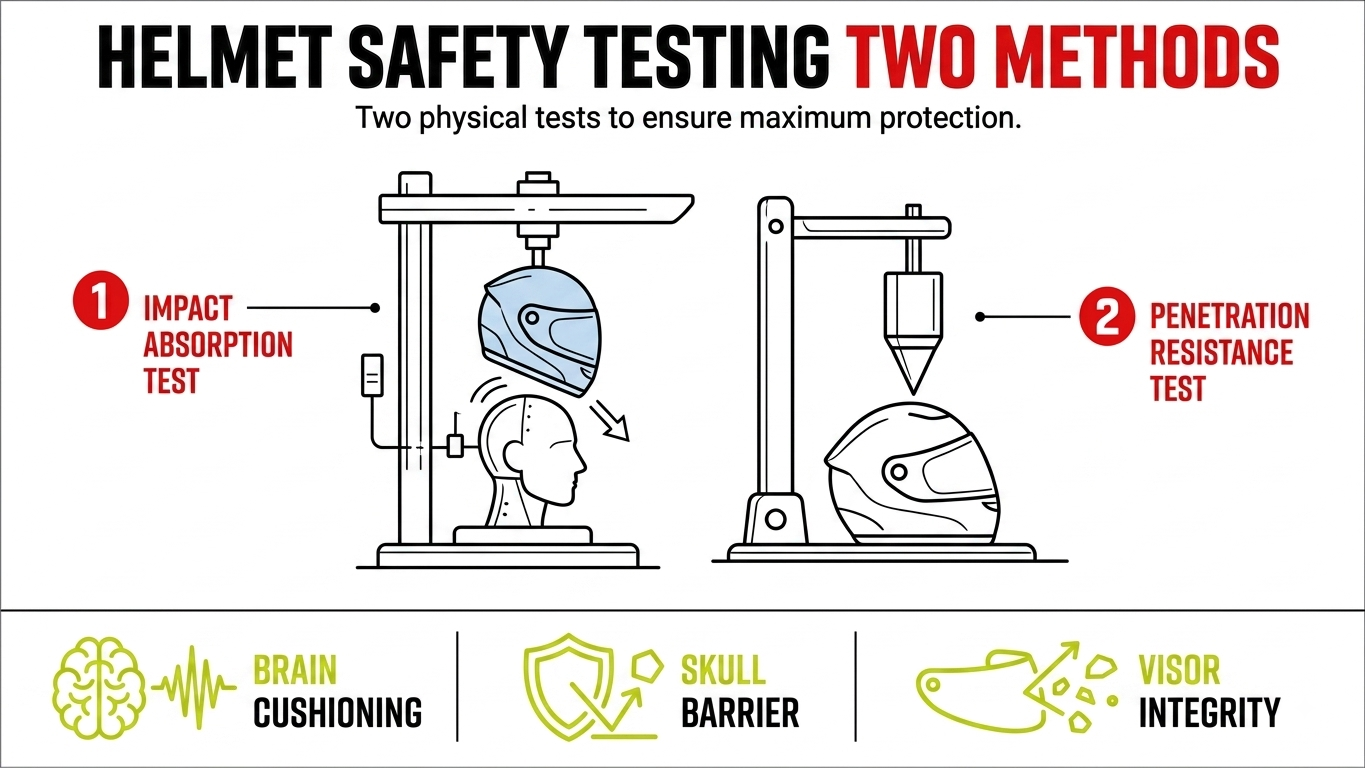
Every certification on a helmet traces back to two fundamentally different physical tests, and understanding the difference between them explains a lot about why the standards are structured the way they are.
Impact absorption testing measures how much force reaches your skull during a crash. A metal headform fitted with accelerometers goes inside the helmet, and the whole assembly is dropped onto an anvil at a controlled speed. The helmet's job isn't to prevent the impact; it's to slow down how quickly that force reaches your head by crushing the EPS foam liner in a controlled way.
A stiffer liner transmits force faster and harder; a liner engineered to crush progressively spreads that same energy over more time, which is gentler on your brain even though the total energy involved is identical. This is why helmet foam looks crushed and compressed after a real crash: that visible damage is the liner doing exactly its job.
Penetration testing is a completely different mechanism, checking whether a sharp or pointed object can punch straight through the shell to reach your head. A weighted striker with a pointed tip is dropped onto the shell from a set height, and the pass condition is simple: it can't make contact with the headform underneath. This test has nothing to do with cushioning or force transmission; it's purely about whether the shell itself holds together against a road hazard's sharp edges, a curb corner, or debris.
Under ECE 22.06 specifically, this penetration concept extends beyond the shell to the visor too. Independent reporting on the standard describes a test firing a 6mm steel ball at roughly 80 meters per second, close to 180 mph, directly at the visor to simulate high-speed road debris.
The visor has to stop the ball, and if it does break, it can't shatter into sharp shards that could injure the rider's face.
What Is Homologation? Understanding Type Approval and Certification Marks
"Homologation" shows up constantly in helmet marketing, and it has a precise meaning: it's the formal process of getting a product officially approved by a recognized regulatory authority before it can legally be sold in that authority's jurisdiction. This is fundamentally different from a manufacturer simply stating "this helmet meets safety standard X."
ECE is the clearest example of true homologation in motorcycle helmets. According to the United Nations Economic Commission for Europe (UNECE), the body that writes and administers ECE Regulation No. 22, every ECE-certified helmet batch is independently lab-tested by an accredited technical service before it's approved, and each approved model receives a type-approval number as part of a marking system specifically designed to prevent counterfeiting.
That's why an ECE sticker, usually found near the chin strap rather than on the back of the shell, includes an "E" mark followed by a country code and a specific approval number, not just the word "ECE."
DOT works differently, and understanding that difference is the single most important thing in this whole topic. DOT operates on a self-certification model: the manufacturer tests the helmet against FMVSS 218 requirements and certifies compliance themselves, and the National Highway Traffic Safety Administration audits the market afterward, buying helmets and testing them after they're already for sale rather than approving them beforehand.
Snell sits closer to the ECE model in spirit, independent, pre-market lab testing, but it's entirely voluntary rather than government-mandated.
Practically, this means an ECE or Snell sticker represents a specific, verified batch that passed a real lab test before reaching you. A DOT sticker represents the manufacturer's own claim, backed by the threat of enforcement action if they're later found to be lying, but not verified in advance for that specific helmet.
DOT vs ECE 22.06 vs Snell: Side-by-Side Comparison
|
DOT (FMVSS 218) |
ECE 22.06 |
Snell M2025 |
|
|
Governing body |
U.S. NHTSA |
UNECE (UN, 45+ countries) |
Snell Memorial Foundation (nonprofit) |
|
Certification model |
Self-certified |
Independently tested, homologated |
Independently tested, voluntary |
|
Impact points tested |
4 |
Up to 18 |
6 different anvil types |
|
Speeds tested |
Single speed |
Three speeds (low, standard, high) |
Higher energy levels than DOT or ECE |
|
Rotational impact testing |
No |
Yes, added in 22.06 |
Yes |
|
Visor/accessory testing |
No |
Yes |
Limited |
|
Legally required in US? |
Yes |
No, but globally accepted |
No, voluntary |
None of these three makes the others irrelevant. They're answering different questions: DOT asks "does this meet the legal floor," ECE 22.06 asks "does this perform across a broad range of realistic crash angles and speeds," and Snell asks "how much raw energy can this absorb before failing."
ECE 22.05 vs ECE 22.06: What Actually Changed
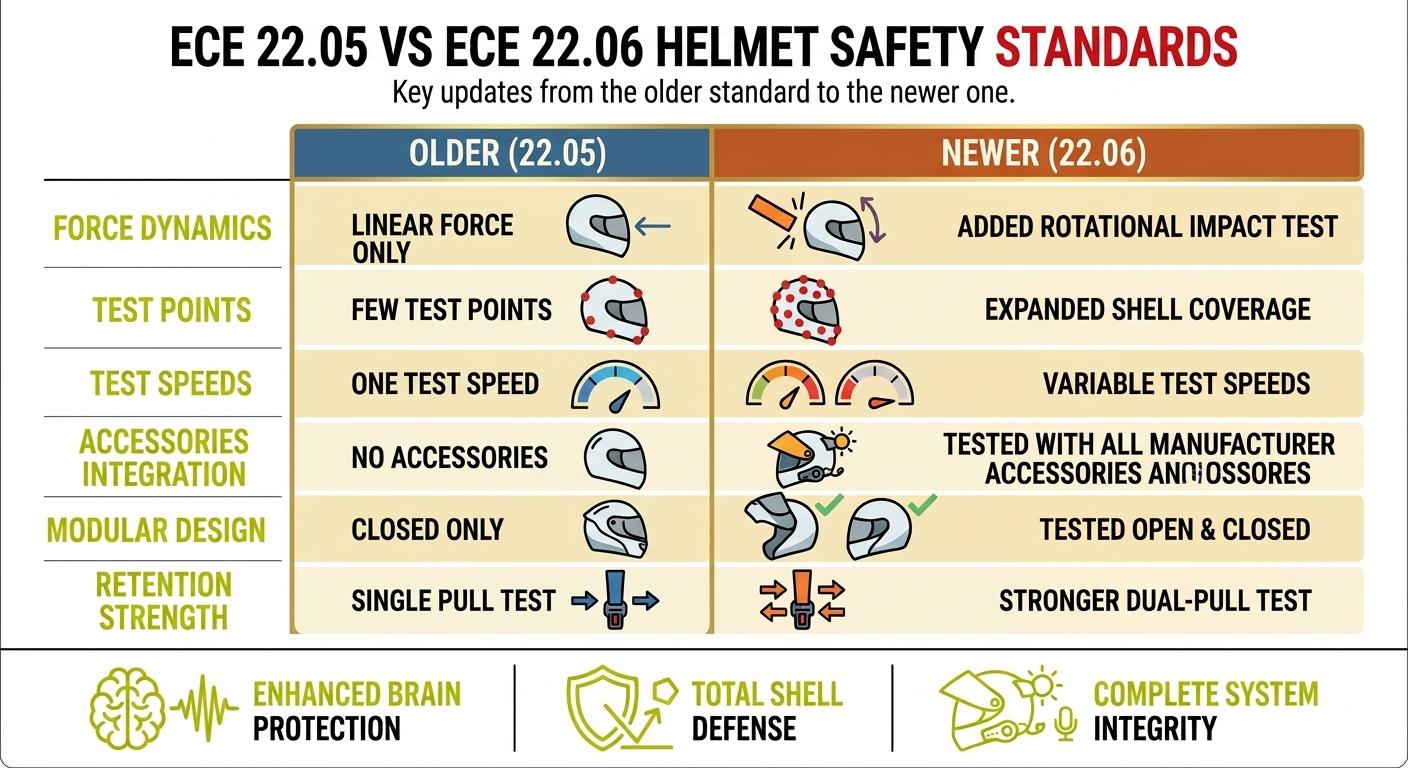
Since ECE 22.06 replaced the older 22.05 standard, and both are still technically in circulation, it's worth understanding specifically what changed rather than just treating the version number as a marketing detail:
- Rotational impact testing, added entirely. ECE 22.05 tested only straight-on, linear impacts. 22.06 adds a test where the helmet strikes an angled anvil, generating both linear and rotational force simultaneously, since real-world crashes are rarely perfectly perpendicular.
- Impact points expanded significantly. ECE 22.05 tested a handful of points on the shell (commonly cited around 5 to 6). ECE 22.06 expands that to as many as 18 points, covering areas of the shell the old standard never touched.
- Multiple test speeds instead of one. ECE 22.05 tested primarily at one standard speed. ECE 22.06 adds both a higher-speed test and a separate lower-speed test, since a liner tuned only for high-energy impacts can actually be too stiff for a gentler hit, transmitting more force than a properly tuned liner would.
- Visors and accessories are now part of the test. Sun visors, communication mounts, and other manufacturer-approved accessories are tested as fitted, since anything attached to the shell can change how it performs in a crash.
- Modular helmets are tested in both positions. ECE 22.05 only tested modular (flip-up) helmets with the chin bar closed. 22.06 requires testing in both the open and closed position.
- The retention system test got tougher. A reverse-direction pull test was added on top of the existing forward test, checking that the chin strap holds under a wider range of real crash forces.
That last point about impact points and speeds is genuinely the headline change, and it's not a minor revision. According to UNECE's own proposal documentation for the 06 series amendments, rotational acceleration protection was specifically identified as a required new area of testing, alongside a redesigned type-approval marking system meant to close gaps the older standard left open.
Is ECE Better Than DOT? What "Better" Actually Means Here
This is the question underneath most of the others, and the honest answer is that ECE 22.06 tests a meaningfully broader set of real-world scenarios than DOT does, but "better" isn't quite the right frame for what's actually happening.
DOT tests fewer impact points, at a single speed, with no rotational component, and it relies on the manufacturer's own self-certification rather than an independent lab result for that specific helmet before sale.
ECE 22.06 tests more points, at multiple speeds, includes rotational impact testing that DOT has never required, and every certified batch goes through independent lab testing before it reaches the type-approval stage. On pure testing rigor and scope, ECE 22.06 is the more comprehensive standard, and most safety researchers and helmet engineers treat it that way.
What DOT has that ECE doesn't is legal force in the United States: it's the only certification actually required to ride legally on US roads. A helmet can carry DOT alone and be completely street-legal everywhere in the country, even though it's tested against a narrower set of scenarios than an ECE 22.06 helmet would be.
Increasingly, premium helmets sold in the US carry both certifications side by side specifically because manufacturers recognize that DOT alone tests a narrower slice of what actually happens in a real crash.
Frequently Asked Questions
Which is better, DOT or Snell?
Snell is generally considered the more rigorous of the two on raw testing severity. Snell M2025 tests at higher energy levels than DOT's baseline requirements, uses a wider variety of anvil shapes including an aggressive edge anvil, and is independently lab-tested rather than self-certified. DOT's advantage is that it's the only one of the two that's legally required for street riding in the US; Snell is a voluntary standard some manufacturers pursue on top of DOT, not instead of it.
Is ECE 22.06 the same as DOT?
No, they're structurally different systems. DOT is a US self-certification standard under FMVSS 218, administered by NHTSA with after-the-fact market audits. ECE 22.06 is a UN-regulated, independently pre-tested and homologated standard used across more than 45 countries. A helmet can carry either certification alone or both together, and many premium helmets sold in the US do carry both.
Are AGV helmets DOT or ECE certified?
Typically both, depending on the specific model and market. AGV generally certifies its street helmets to DOT for the US market and ECE 22.06 for international markets, with many models carrying dual certification. AGV helmets are generally not Snell-certified, since Snell is a separate voluntary standard most manufacturers pursue selectively rather than across their full lineup.
Which is the No. 1 helmet brand?
No single brand, and be skeptical of anyone who claims otherwise. What actually varies between brands is which certifications they pursue and how consistently they hit them across their lineup. HJC and Scorpion both offer solid DOT-and-ECE dual-certified options at accessible prices; Bell spans a wider range from budget to premium. Match the certification and fit to your needs first, brand loyalty second.
Certification Labels Explained, Not Just Sold
A lot of retailers slap certification badges on a page without explaining what any of them mean. Perf-Moto carries DOT- and ECE-certified helmets across dozens of brands, and the goal here was to actually explain what those labels test, not just list them as a bullet point, because a rider who understands the difference makes a better decision than one just looking for the most badges on a box.
Questions about a specific helmet's certification before you buy? Reach the team directly, Monday through Friday, 9 am to 5 pm EST.
Browse certified helmets filtered by DOT, ECE, or Snell rating.