

Short answer: The best trail MTB helmet for most riders is a well-fitting half-shell with rotational-impact protection, secure rear coverage, good ventilation, and a visor that works with goggles. The Fox Speedframe MIPS is the straightforward all-round choice. The Speedframe Pro adds a dual-density liner and Fidlock buckle, while the Speedframe RS adds MIPS Integra Split, BOA adjustment, and higher-end features. Choose the Fox Dropframe if you want more coverage around your ears and the sides of your head without moving to a full-face helmet. For value, the 100% Altec with Fidlock is worth comparing, especially at Perf-Moto's discounted prices.
This guide compares Fox Speedframe, Speedframe Pro, Speedframe RS, Dropframe, and 100% Altec helmets by protection technology, coverage, fit, ventilation, visor design, and price. It also explains when a half-shell is enough and when your riding calls for more coverage.
Key Takeaways
- Best everyday trail helmet: Fox Speedframe MIPS combines adjustable fit, ventilation, and MIPS in a conventional half-shell.
- Best performance-value upgrade: Speedframe Pro adds dual-density Varizorb EPS, Fidlock closure, and a goggle-compatible visor.
- Best premium half-shell: Speedframe RS uses Mips Integra Split, BOA adjustment, and Fidlock. It also earned a five-star Virginia Tech helmet rating.
- Best extended coverage: Fox Dropframe covers more of the sides of the head and ears than a standard half-shell. It is still not a full-face helmet.
- Best budget alternative: 100% Altec uses a 14-point Smartshock system, 15 vents, an adjustable visor, and a Fidlock buckle.
- Fit comes first: A helmet should sit level, feel uniformly snug, and remain secure when you move your head.
Browse Perf-Moto's helmet collection for mountain bike helmets and available sizes.
Quick Picks: Best Trail MTB Helmets by Riding Style
|
Riding need |
Pick |
Key features |
Perf-Moto price* |
|
Everyday trail riding |
Fox Speedframe Solid |
MIPS, 360° fit, adjustable visor |
119.95–129.95 |
|
Performance trail riding |
Fox Speedframe Pro FA24 |
MIPS, Varizorb EPS, Fidlock, 3-position visor |
82.70–85.01 sale |
|
Premium trail and enduro |
Fox Speedframe RS Paranoid |
Mips Integra Split, BOA, Fidlock |
145.98–173.85 sale |
|
Extended side and ear coverage |
Fox Dropframe / Dropframe Pro |
Three-quarter-shell design |
Check availability |
|
Budget trail helmet |
100% Altec w/Fidlock |
Smartshock, 15 vents, Fidlock |
32.36–39.09 sale |
|
Affordable full-face alternative |
O'Neal Sonus |
Full-face shell, adjustable visor, Fidlock |
$89.99 |
Prices displayed during research in November 2026. Sale prices depend on the product version, color, and size. Stock and pricing can change. The Dropframe price was not confirmed at Perf-Moto.
What Is the Best Half-Shell Mountain Bike Helmet in 2026?
For most trail riders, the Fox Speedframe is a practical starting point. It offers a fit-adjustment system, rotational-impact technology, and a visor designed to work with sunglasses or goggles.
The Speedframe Pro makes sense when you want additional features without changing to a different style of helmet. Its dual-density EPS and magnetic buckle are meaningful upgrades.
If you want the highest-end Speedframe in this comparison, consider the RS. Its newer impact-management construction, adjustable fit system, and independent test results make it a strong premium option.
The 100% Altec is the value alternative. It offers several features associated with more expensive trail helmets, but uses a different rotational-protection technology.
The Dropframe serves a different rider. Its coverage extends around the ears and sides of the head, making it useful for riders who want more coverage than a conventional open-face helmet provides.
There is no single winner for everyone. Head shape, riding style, and the helmet's actual fit matter more than choosing the model with the longest specification sheet.
Best Fox Speedframe MTB Helmets
Fox Speedframe MIPS: Best Everyday Trail Helmet
The Fox Racing Speedframe Solid MTB Helmet is a conventional half-shell built for regular trail riding.
Its standout features include:
- MIPS rotational-impact management.
- Optimized ventilation with channels molded into the EPS liner.
- One-hand-adjustable visor compatible with sunglasses and goggles.
- Integrated sunglass storage.
- Removable, washable moisture-wicking liner.
- 360-degree fit adjustment system.
The fit system lets you adjust how firmly the helmet sits around your head without relying on the chinstrap alone.
Ventilation is another advantage. The Speedframe's open-face construction and internal air channels are suited to rides with sustained climbing, particularly when you are producing plenty of heat.
Perf-Moto lists the Speedframe Solid at 119.95–129.95.
Choose it if: you ride local trails, climb regularly, and want the essential features of a dedicated MTB helmet without paying for every premium upgrade.
Fox Speedframe Pro: Best Performance Upgrade
The Fox Racing Speedframe Pro FA24 takes the standard Speedframe design further.
Key features include:
- MIPS rotational-impact protection.
- Dual-density Varizorb EPS designed to distribute impact forces.
- Fidlock SNAP magnetic chinstrap buckle.
- Removable, washable XT2 antimicrobial liner.
- Optimized ventilation with channeled EPS.
- Goggle-compatible, three-position visor.
- 360-degree fit adjustment.
The Pro's additional features are particularly useful for riders who spend long hours on the bike.
The Fidlock buckle is easier to operate while wearing gloves than many conventional buckles. The adjustable visor helps when switching between sunglasses and goggles, while the removable liner makes cleaning easier.
Perf-Moto lists the FA24 version at 82.70–85.01 on sale, against a listed price of $189.95.
An additional Speedframe Pro Lunar FA21 listing is priced at $63.51. Check the exact version before ordering, since model-year graphics and specifications can differ.
Choose it if: you want an upgraded trail helmet with MIPS, dual-density foam, and Fidlock closure, particularly when an older colorway is heavily discounted.
Fox Speedframe RS: Best Premium Trail Helmet
The Fox Racing Speedframe RS Paranoid is designed for riders who want a more advanced open-face helmet.
Instead of the conventional MIPS system used on the other Speedframe versions, the RS uses MIPS Integra Split.
This design combines two foam densities with a low-friction layer between them to help manage rotational motion during certain impacts.
The listing highlights:
- Mips Integra Split dual-density protection system.
- BOA Fit System for small adjustments.
- Fidlock SNAP magnetic buckle.
- Removable Ionic+ moisture-wicking liner.
- Optimized ventilation and channeled EPS.
- Three-position adjustable visor.
- Integrated sunglass storage.
- Removable under-visor GoPro mount.
- NTA-8776 e-bike certification.
The Speedframe RS also earned a five-star rating from Virginia Tech's Bicycle Helmet Ratings program, with a STAR score of 7.23.
Virginia Tech's testing measures helmet performance across multiple impact scenarios. Its results are useful for comparison, although no laboratory score guarantees protection in every crash.
Perf-Moto lists the RS Paranoid at 145.98–173.85 on sale, compared with a regular price range of 279.95–319.95.
Choose it if: you ride technical trails or enduro-style terrain, want premium adjustment features, and value independent helmet-test performance.
Fox Speedframe vs Dropframe: What's the Difference?
The biggest difference between the Speedframe and Dropframe is coverage.
The Speedframe is a traditional open-face MTB helmet. It covers the top, sides, and rear of the head while leaving the ears exposed.
The Dropframe uses a three-quarter-shell design. Its structure extends lower around the ears and sides of the head.
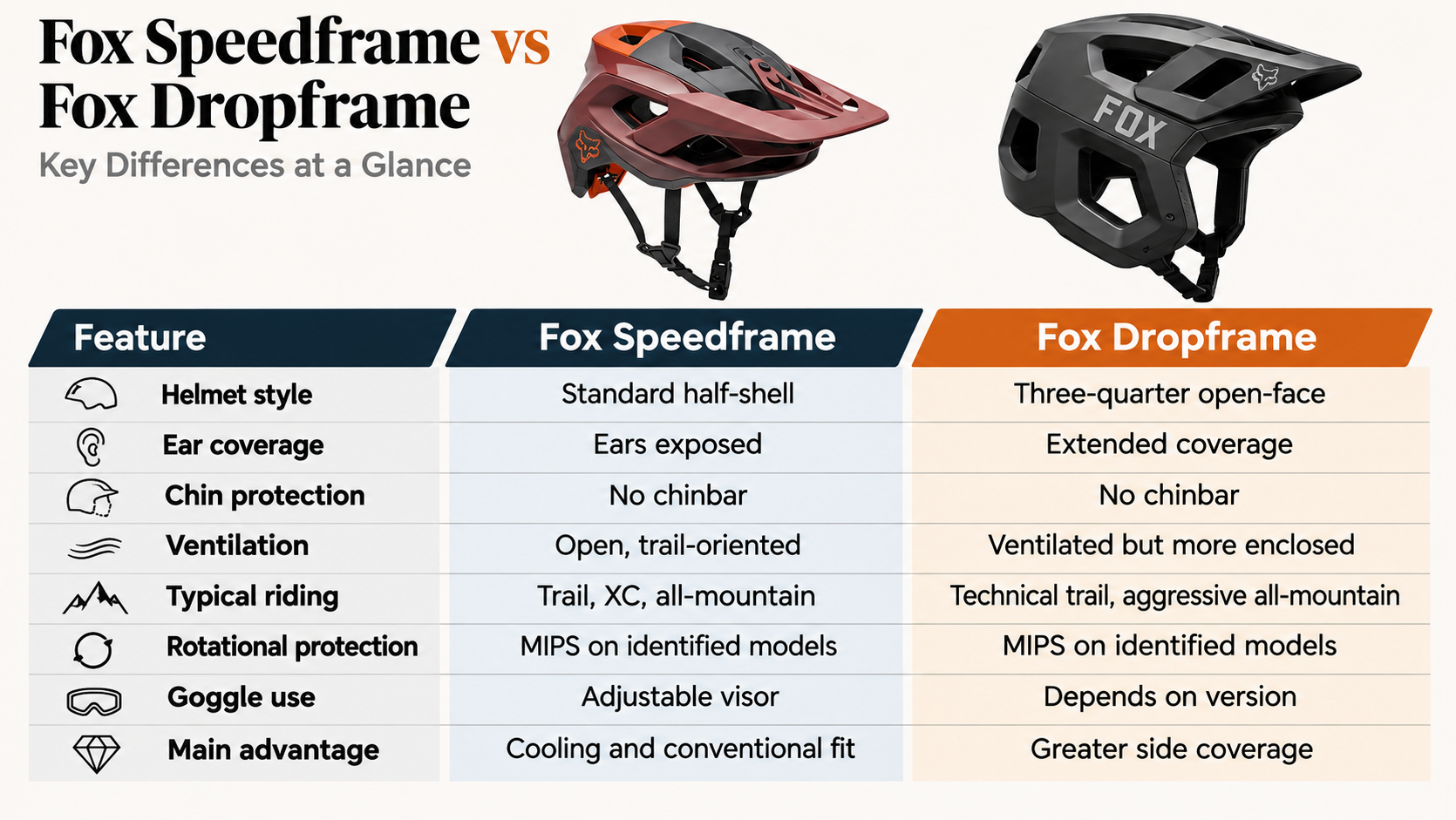
Who Should Buy the Fox Dropframe?
The Dropframe is worth considering if you ride technical trails with frequent rocks, roots, steep sections, and other situations where you prefer more coverage around the side of your head.
Fox's Dropframe lineup includes standard and Pro versions.
The standard Dropframe is described by Fox as having MIPS, a Varizorb EPS liner, 15 vents, a fixed visor, and Fidlock closure.
The Dropframe Pro adds higher-end features depending on the version, including BOA adjustment, an eyewear-compatible design, and adjustable visor options.
The important limitation is that neither design provides the chin and face coverage of a certified full-face helmet.
We couldn't confirm a current purchasable Dropframe helmet listing on Perf-Moto during research. A replacement Dropframe visor is listed, but that does not establish helmet availability.
Choose it if: you want extended side coverage while retaining an open-face design. Contact Perf-Moto about current stock and the exact version.
For riding that calls for chin protection, move to an appropriate full-face MTB helmet rather than treating a Dropframe as equivalent.
100% Altec w/Fidlock: Best Budget Trail Helmet
The 100% Altec MTB Helmet with Fidlock is an alternative to the Fox Speedframe lineup.
Its most important distinction is the Smartshock Rotational Protective System, which uses 14 points within the helmet construction.
This is not MIPS. Both systems are intended to address rotational motion, but their engineering approaches differ.
The Altec's features include:
- 14-point Smartshock rotational-protection system.
- Multi-density EPS foam with an in-molded polycarbonate shell.
- 15 ventilation openings.
- Extended head coverage.
- Multi-position adjustable visor.
- Goggle-stowage compatibility.
- Integrated sunglasses storage.
- Washable moisture-wicking antimicrobial liner.
- Adjustable ratcheting fit system.
- Fidlock SNAP magnetic buckle.
- Additional comfort liner for fit customization.
The included extra liner is useful if the helmet's initial fit is close but not quite right.
The magnetic buckle is another practical feature at this price. It makes opening and fastening the strap easier while wearing riding gloves.
Perf-Moto lists the Altec at 32.36–39.09 on sale, compared with a regular price of $165.
That makes it a particularly interesting value option.
There is one qualification: the Altec's low sale price should not be treated as evidence that it performs identically to a more expensive helmet. Evaluate its certification, fit, and available independent testing separately.
Choose it if: you want a well-equipped trail helmet with rotational-impact technology, goggle compatibility, and a Fidlock buckle at a discounted price.
Fox Speedframe vs 100% Altec: Which Should You Buy?
Choose the Fox Speedframe if you prefer a conventional MIPS-equipped helmet, Fox's fit system, and the familiar Speedframe design.
Choose the Altec if its fit suits your head and you want to spend less while retaining features such as rotational-impact management, an adjustable visor, and Fidlock closure.
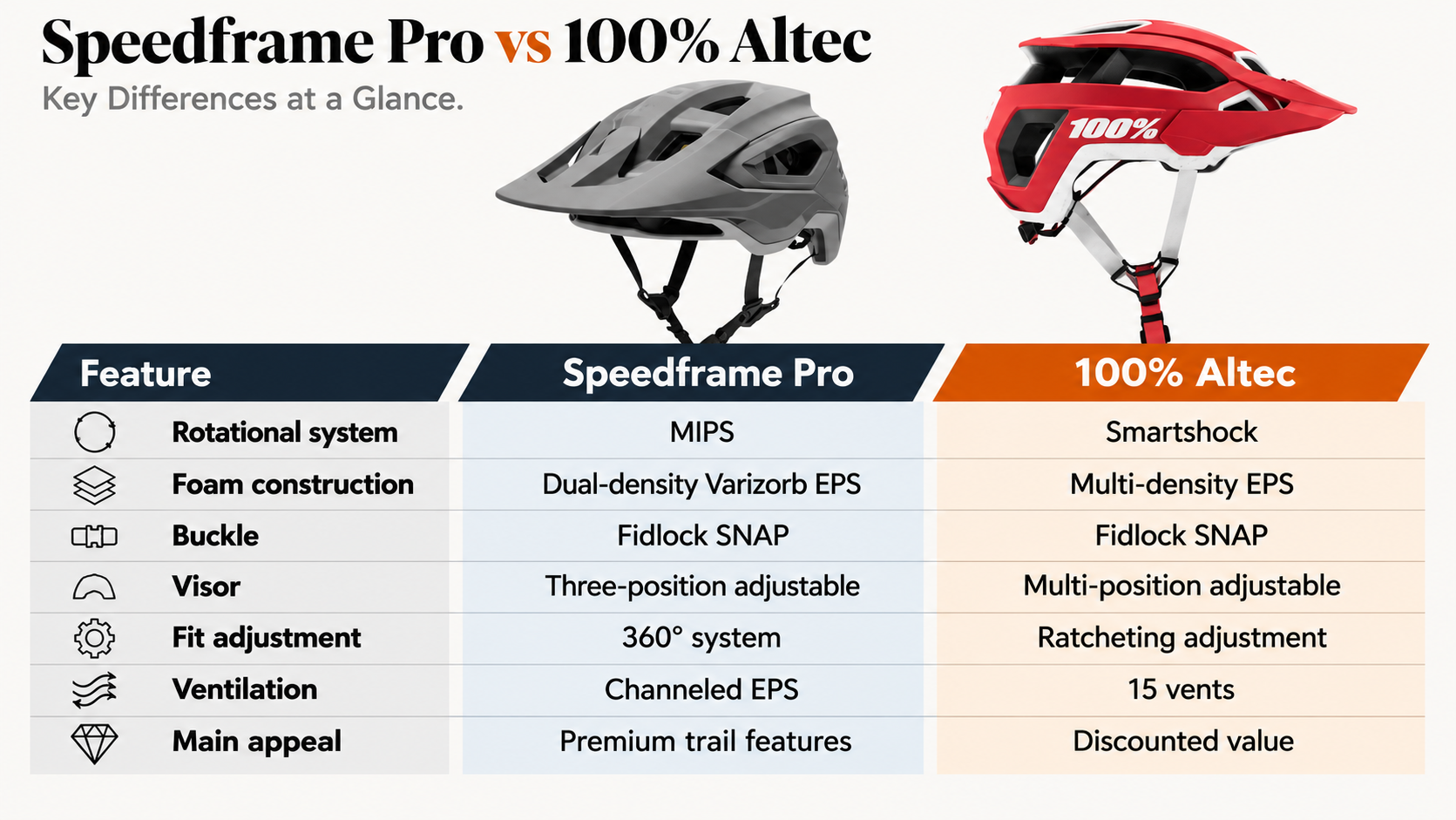
For riders comparing the Speedframe Pro and Altec, the distinction becomes more specific:
Neither the presence of MIPS nor the number of vents proves one helmet is safer or cooler than the other.
The final choice should account for your fit, the particular version's test results, and the conditions in which you ride.
Is a MIPS Trail Helmet Worth It?
For many mountain bikers, a well-fitting helmet with rotational-impact management is worth considering.
MIPS stands for Multi-directional Impact Protection System.
The technology is designed to allow controlled relative movement within the helmet during certain angled impacts, with the aim of reducing rotational motion transmitted to the head.
Rotational motion matters because bicycle crashes frequently involve angled contact rather than perfectly straight impacts.
However, MIPS is not a guarantee against concussion, and it should not be treated as a substitute for a properly fitting, certified helmet.
There are also alternative systems, including 100%'s SmartShock.
When comparing helmets, use this order:
- Confirm that the helmet meets the relevant bicycle safety standard.
- Check whether it fits your head securely and comfortably.
- Review any available independent impact-testing results.
- Compare rotational-impact technology, coverage, ventilation, and convenience features.
A comfortable certified helmet that fits correctly is a better choice than an expensive helmet that shifts around your head.
What Do Virginia Tech's MTB Helmet Ratings Mean?
Virginia Tech uses its STAR testing methodology to evaluate helmet performance in a range of impact scenarios.
The laboratory measures linear acceleration and rotational velocity, which are associated with head-injury risk.
Its rating system awards up to five stars, with higher-rated helmets associated with better performance in its tests.
The Fox Speedframe RS has a five-star result and a STAR score of 7.23.
The Dropframe Pro has also earned five-star ratings in tested versions, but those results belong to the specific versions evaluated, not automatically to every Dropframe sold under the name.
Independent ratings are helpful, particularly when two helmets both fit well. However, laboratory performance is not a prediction of exactly what will happen in an individual crash.
What Features Matter Most in a Trail MTB Helmet?
MIPS or Other Rotational-Impact Protection
Look for a clearly identified protection system rather than assuming every helmet from the same brand uses identical technology.
The Fox Speedframe family includes multiple MIPS implementations. The 100% Altec uses Smartshock.
Extended Rear and Side Coverage
Trail helmets commonly extend farther down the rear of the head than some minimalist road helmets.
The Dropframe goes farther by covering the ear area as part of its three-quarter-shell construction.
More coverage can be desirable, but shape and coverage alone do not establish a helmet's overall protective performance.
Ventilation
A helmet that manages heat well is easier to wear through long climbs.
The Speedframe uses molded air channels, while the Altec lists 15 ventilation ports.
Vent placement and internal airflow matter as much as the number of openings.
Goggle-Compatible Visor
An adjustable visor helps you switch between sunglasses and goggles.
The Speedframe Pro and RS have three-position visors, while the Altec uses a multi-point adjustment system.
Before buying, check that your goggles fit beneath the visor and sit against your face without leaving an awkward gap.
Fidlock Buckle
Fidlock uses a magnetic-assisted closure mechanism designed for easy fastening and release.
It is especially convenient when wearing gloves.
The Speedframe Pro, Speedframe RS, and Altec include Fidlock closures in the versions discussed here.
Helmet Weight
Weight matters during long climbs, especially when you spend several hours on the bike.
As manufacturer reference figures, Fox lists a medium Speedframe MIPS at approximately 360 ± 30 g and a medium Speedframe Pro at approximately 380 ± 30 g.
These figures apply to the referenced configurations and should not be assigned automatically to every graphic, model year, or version.
For the Speedframe RS, Dropframe, and Altec, check the exact size and listing for the relevant weight.
Fit and protection should take priority over small weight differences.
How Should a Mountain Bike Helmet Fit?
A mountain bike helmet should sit level and securely on your head without causing localized pressure.
Start by measuring your head circumference with a flexible tape around the widest part, generally just above your eyebrows and ears.
Then:
- Check the size chart. Use the manufacturer's chart for the exact model, not a generic helmet size.
- Position the helmet correctly. The front should cover your forehead without blocking your vision.
- Adjust the retention system. Tighten it until the helmet feels secure, but not painfully tight.
- Check the sides and rear. The shell should not wobble or lift easily when you move your head.
- Fasten the chinstrap. It should be snug enough to hold the helmet in position.
- Test your eyewear. Wear your sunglasses or goggles during the fit check.
- Look for pressure points. Uneven pressure on the forehead or temples may indicate that the helmet shape does not suit your head.
A correctly sized helmet should remain stable when you look down, turn your head, or move over rough ground.
Do not buy a larger helmet solely to avoid a pressure point. A different shape may solve the problem more effectively.
If the helmet is between sizes, consult the model's fit guidance and try both sizes where possible.
Half-Shell vs Full-Face MTB Helmet: Which Is Better?
A half-shell helmet is often the practical choice for ordinary trail riding.
It is easier to wear during long climbs, offers broad visibility, and generally feels less enclosed.
A full-face helmet adds a chinbar and more facial coverage, which is valuable for downhill riding, bike parks, and higher-consequence terrain.
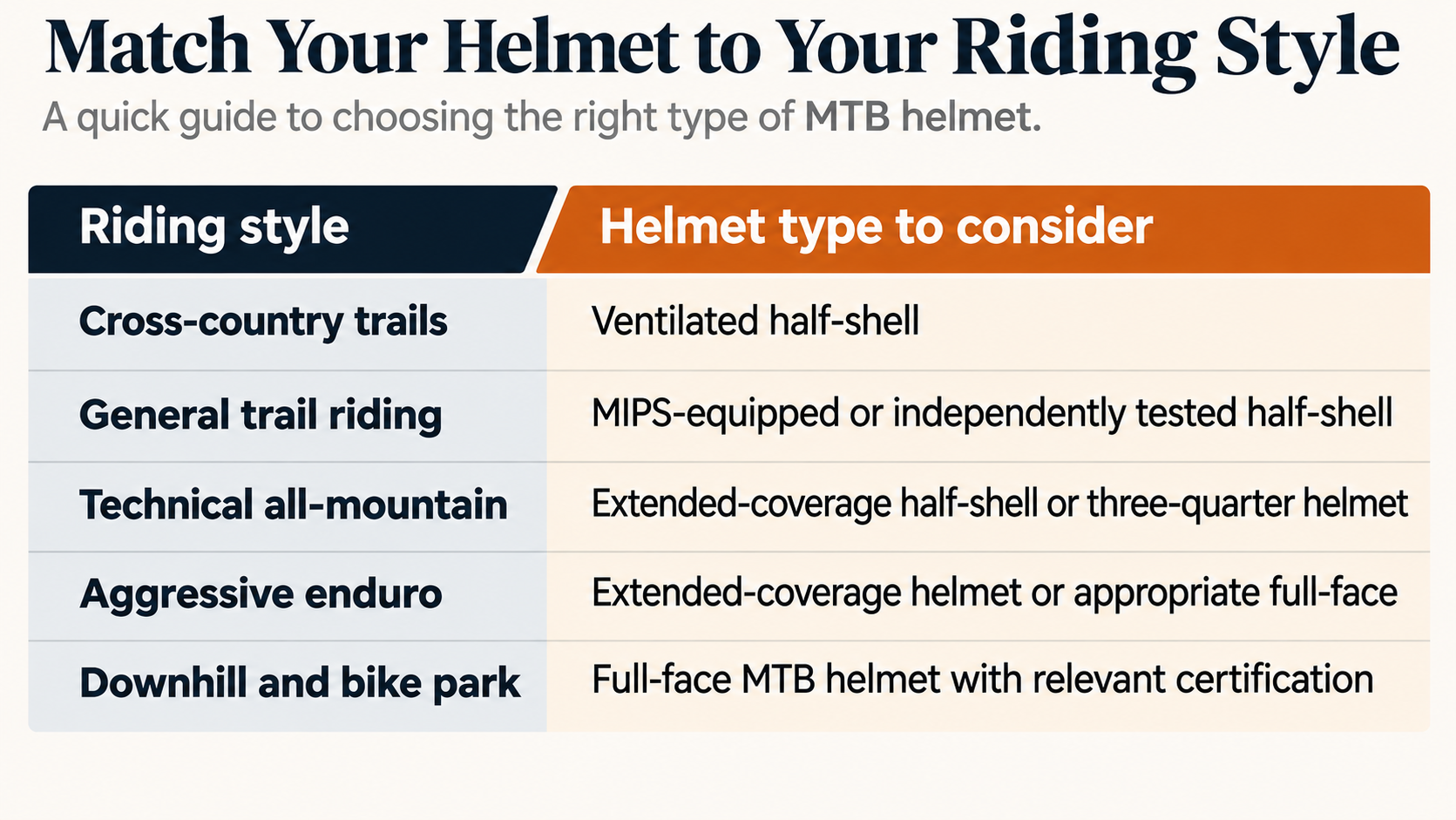
For riders who want full-face coverage on a budget, Perf-Moto lists the O'Neal Sonus MTB Helmet at $89.99.
The Sonus features an ABS shell, multiple ventilation openings, a removable washable liner, adjustable visor, and Fidlock buckle. Its listing identifies the EN 1078 bicycle helmet standard.
For dedicated downhill riding, look for a full-face helmet specifically certified to ASTM F1952 rather than assuming all full-face helmets meet that standard.
Perf-Moto also lists the Fox Proframe RS, which specifies ASTM F1952 certification.
The Backflip helmet family is another full-face option to investigate, but we couldn't verify a current purchasable Backflip helmet listing at Perf-Moto. Confirm stock and certification before choosing it.
How Often Should You Replace a Trail MTB Helmet?
Replace your helmet after a significant impact, especially if it struck the ground or another object during a crash.
Damage to the internal EPS structure is not always obvious from the outside.
Also replace a helmet if you notice cracks, compromised straps, a damaged buckle, or deterioration that prevents a secure fit.
For helmets that have never been crashed, follow the manufacturer's replacement guidance. Storage conditions, UV exposure, heat, and wear can affect useful life.
Avoid buying a used helmet when its impact history is unknown.
FAQs About Trail MTB Helmets
What is the best half-shell mountain bike helmet in 2026?
The Fox Speedframe MIPS is a strong everyday choice because it combines rotational-impact protection, ventilation, adjustable fit, and a goggle-compatible visor. For premium features and independent testing, consider the Speedframe RS. For budget value, compare the 100% Altec.
Fox Speedframe vs Dropframe: which is better?
Choose the Speedframe for a conventional, ventilated half-shell suited to most trail riding. Choose the Dropframe if you prefer more coverage around your ears and sides of the head. Neither has a full-face chinbar.
Is a MIPS trail helmet worth it?
A well-fitting MIPS helmet is worth considering because its system is designed to manage rotational motion during certain angled impacts. It does not eliminate concussion risk, and helmet fit, certification, and independent testing remain important.
What's the difference between Fox Speedframe and Speedframe Pro?
The Pro adds dual-density Varizorb EPS, a Fidlock magnetic buckle, and other premium features to the Speedframe design. Both provide trail-oriented ventilation and adjustable fit in the identified versions.
Is the Fox Speedframe RS better than the Pro?
The RS has a more advanced feature set, including Mips Integra Split, BOA adjustment, and an under-visor camera mount. It also earned a five-star Virginia Tech rating. Whether it's the better purchase depends on fit, sale price, and whether you'll use those upgrades.
Does the 100% Altec have MIPS?
No. The 100% Altec uses the brand's 14-point Smartshock Rotational Protective System. It's an alternative rotational-impact system, not a version of MIPS.
Can you wear goggles with a half-shell MTB helmet?
Yes, many trail helmets have visors designed to accommodate goggles. The Speedframe Pro, Speedframe RS, and Altec offer adjustable visors. Check the fit with your particular goggles before riding.
Is a Dropframe helmet enough for downhill riding?
A Dropframe provides more side coverage than a standard half-shell, but it lacks a chinbar. For dedicated downhill riding or bike parks requiring full-face protection, choose a suitable full-face MTB helmet with the relevant safety certification.
Are more helmet vents always better?
No. The number of vents alone does not determine cooling performance. Their position, internal channels, fit, and airflow while riding all affect ventilation.
How tight should a trail MTB helmet be?
It should feel uniformly snug without painful pressure. The helmet should sit level, remain stable when you move your head, and have a securely fastened chin strap. If you have persistent pressure points, try a different size or head shape.
Shop Trail MTB Helmets at Perf-Moto
Start with fit, then choose the coverage that matches your trails.
For everyday riding, the Fox Speedframe is a practical starting point. Step up to the Speedframe Pro or RS for more premium features. Consider the Dropframe for extended coverage, and the 100% Altec when value is your priority.
If you're updating the rest of your trail kit, read our MTB shorts, pants, and jerseys comparison to help match your riding clothing to the terrain.
For additional savings, see our guide to saving on brand-name powersports gear.
Questions about fit, sizing, or availability? Contact Perf-Moto or call (616) 494-0103, Monday through Friday, 9 AM to 5 PM EST. Free domestic shipping is advertised on the Perf-Moto website; check checkout conditions for your order.