
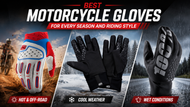
Ask five different riders what the best motorcycle gloves are and you'll get five different answers, and honestly, all five of them might be right for that specific person. Gloves are one of the few pieces of gear where "best" genuinely splits by season and riding style rather than there being one clear winner, because a glove built to keep your hands cool in July would be miserable in January, and a glove built to seal out January wind would leave your hands soaked in sweat by mile ten in July.
So instead of chasing a single "best" pick, it's worth understanding what actually separates a good summer glove from a good winter one, and what knuckle protection ratings are actually telling you before you buy.
Browse Perf-Moto's glove lineup as we go through what to look for by season and use case.
Quick Takeaways
- Summer and winter gloves solve opposite problems. Ventilation and grip matter most in heat; waterproofing and insulation matter most in cold. Few gloves do both well.
- Knuckle protection isn't automatic. Under the EN 13594 standard, it's only mandatory at Level 2, marked with a "KP" tag inside the glove.
- Palm sliders let your hand slide instead of catching and twisting your wrist, which matters more than raw padding thickness in a lot of falls.
- Gauntlet cuffs seal better against wind and water; short cuffs are easier to layer under a jacket sleeve. Neither is objectively correct.
- Touchscreen compatibility is a small feature that matters more in daily use than it sounds like it would.
Best Motorcycle Gloves for Summer: Prioritize Ventilation
If you're specifically hunting for the best motorcycle gloves for summer riding, ventilation and grip matter far more than armor thickness. Heat makes your hands sweat, sweaty hands lose grip on the handlebar, and a glove that traps heat instead of moving air through it works against you exactly when you need reliable control most.
Perf-Moto's Leatt ADV X-Flow 5.5 is built specifically around that problem, with permanent airflow ventilation and a MicronGrip palm that holds up in both wet and dry conditions, plus touchscreen-compatible fingertips so you're not peeling a glove off at every stoplight. It's also available in a short-cuff version if you'd rather tuck the cuff under your jacket sleeve than over it.
Warmest Winter Riding Gloves: Waterproofing Beats Insulation Alone
Here's the mistake a lot of riders make when shopping for the warmest winter riding gloves: they focus entirely on insulation thickness and ignore waterproofing, when wet hands get cold far faster than dry hands do, insulated or not. A genuinely warm winter glove needs a real waterproof membrane, not just a thick liner, because that liner does almost nothing once it's soaked through.
Perf-Moto's Speed & Strength Fame and Fortune is built around exactly that priority, with a textile frame over an actual waterproof membrane, a 180g comfort liner for insulation, and a neoprene cuff that seals against wind at the wrist instead of just flapping loose. Thermoplastic knuckle protectors come along with the weatherproofing, so you're not trading safety for warmth.
Knuckle Protection Explained: What EN 13594 Level 1 and Level 2 Actually Mean
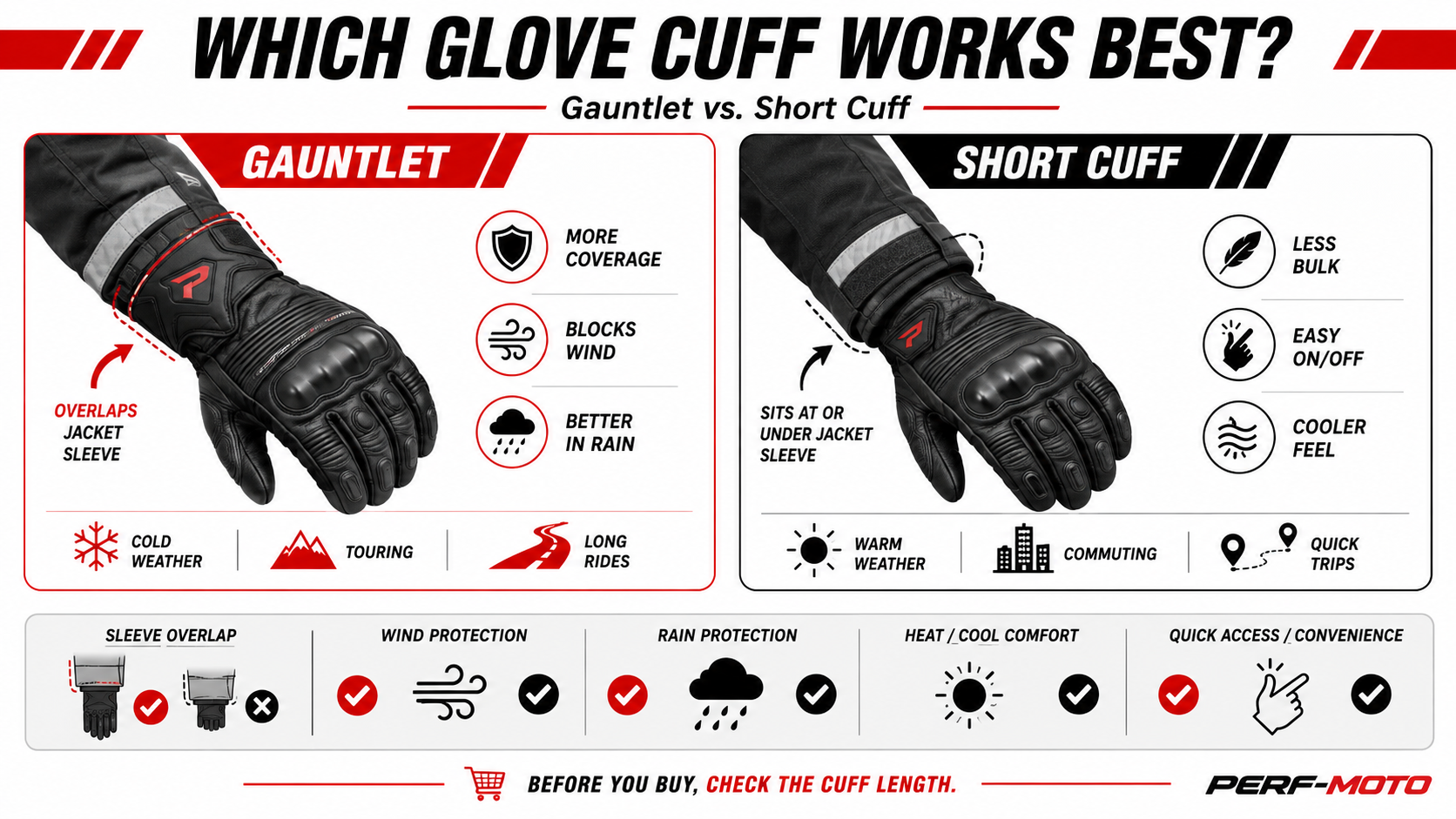
Knuckles are one of the first parts of your hand to hit the ground in a fall, and not every glove that looks armored actually has certified protection there. The European standard covering motorcycle gloves specifically is EN 13594:2015, which sets requirements for sizing, abrasion resistance, tear strength, and impact protection.
The standard splits into two levels. Level 1 covers basic protective performance with lighter ergonomic penalties, meaning the glove moves and flexes more naturally, closer to a bare hand. Level 2 requires meaningfully longer abrasion resistance and, critically, mandatory knuckle impact protection, marked with a "KP" tag inside a certified glove.
According to SATRA, a lab involved in developing protective equipment standards across multiple categories, knuckle protection at Level 1 is optional; a glove can carry Level 1 certification without any knuckle armor at all. If certified knuckle protection specifically matters to you, checking for that KP marking is the only way to know for sure, since "armored-looking" and "certified" aren't the same thing.
Palm Sliders and Grip: The Parts That Do the Work Mid-Slide
A palm slider is a small hard patch, usually plastic or a similarly low-friction material, built into the outer edge of the palm specifically so your hand slides across pavement instead of catching and twisting your wrist during a fall. It sounds like a minor detail until you consider what the alternative looks like: bare fabric or leather catching on asphalt and transferring that sudden stop directly into your wrist joint.
This matters as much as knuckle armor, arguably more for wrist injuries specifically, and it's worth checking for on any glove you're seriously considering, summer or winter. Grip material on the rest of the palm matters too, since a glove that slides well at the edge but loses grip on the bar in normal riding conditions is solving one problem while creating another.
Gauntlet vs Short Cuff: Which Style Fits Your Ride
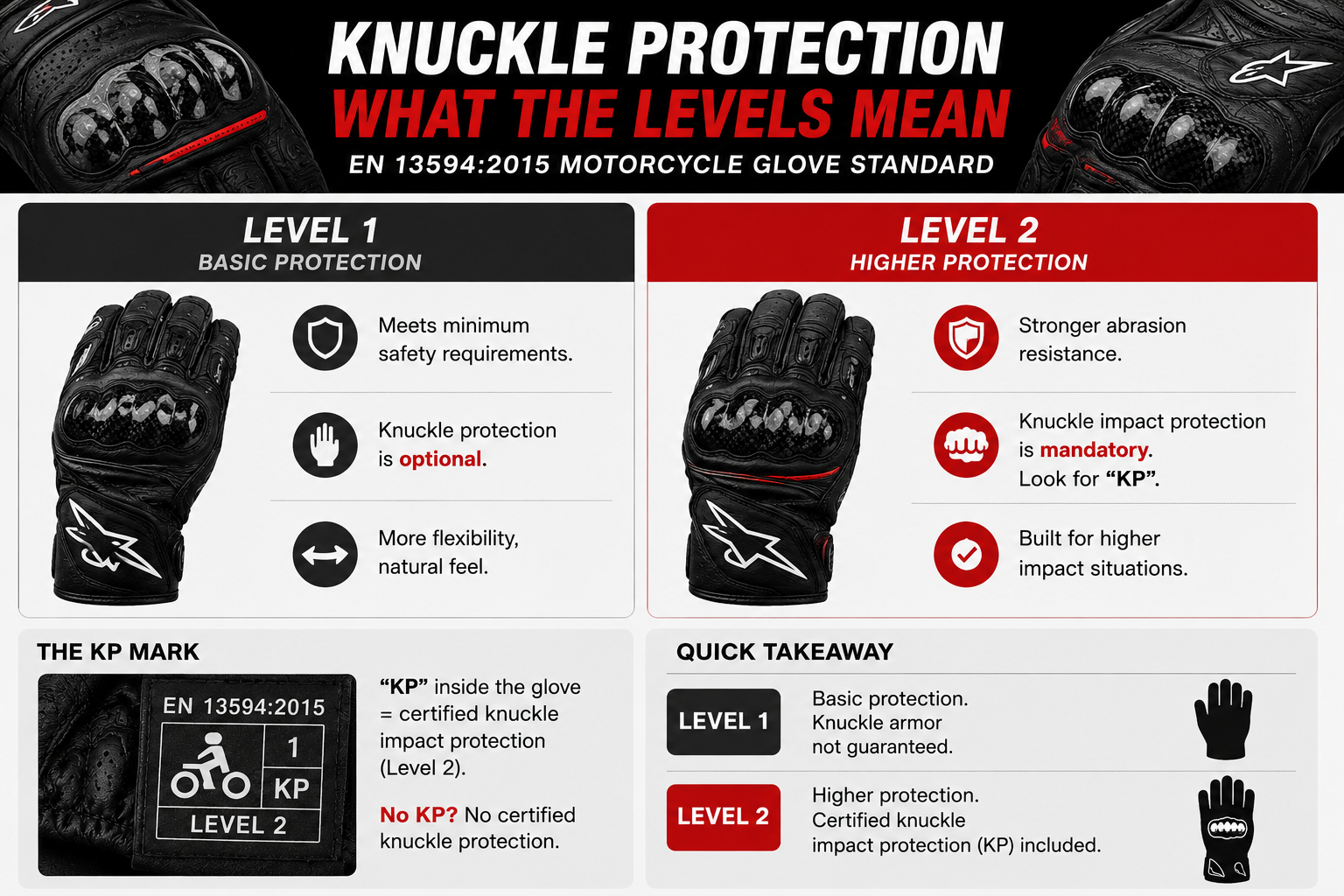
Gauntlet cuffs extend up over the jacket sleeve, sealing out wind and water more effectively since there's no gap at the wrist for cold air to find its way in. Short cuffs tuck under the jacket sleeve instead, trading some of that sealing for a cleaner, less bulky fit and easier on-and-off, especially in warmer weather when sealing out cold air isn't the priority.
Neither style is more "correct." Touring and cold-weather riders tend to prefer gauntlet cuffs for the wind and water sealing, while summer and commuter riders often prefer short cuffs simply because there's nothing to seal against in the first place. If a specific glove doesn't say which style it is, checking the cuff length spec before buying saves a return down the line.
Touchscreen Compatibility: Small Feature, Real Convenience
This one sounds minor until you're standing at a gas station in the cold trying to pull up directions with a glove off and your bare hand freezing in the wind. Both the Leatt ADV X-Flow 5.5 and the Speed & Strength Fame and Fortune build this in directly, using conductive material at the fingertips so a phone screen actually registers your touch through the glove.
It's not a safety feature in the way knuckle armor is, but it's the kind of small convenience that changes how often you actually keep gloves on rather than stripping them off constantly throughout a ride.
Frequently Asked Questions
What type of gloves are best for motorcycle riding?
It depends entirely on season and riding style rather than there being one universal type. Summer and commuting favor ventilated, shorter-cuff gloves with good touchscreen compatibility. Cold or wet-weather riding favors waterproof, insulated gloves with a sealed gauntlet cuff. Track or aggressive street riding tends to favor gloves with certified Level 2 knuckle protection above all else.
What are the best all-year-round motorcycle gloves?
Honestly, most serious riders end up with at least two pairs rather than one true all-season glove, the same way most riders end up with more than one jacket. A single glove trying to handle both a 95-degree day and a 35-degree morning commute usually compromises on both ends rather than excelling at either.
What are the best gloves for summer riding?
Ventilated construction, a grippy palm that performs even when your hands sweat, and touchscreen-compatible fingertips so you're not removing gloves constantly at stops. Perf-Moto's Leatt ADV X-Flow 5.5 checks all three boxes if you want a concrete example to compare other options against.
Who makes the best quality gloves?
No single brand owns this across every category, and glove quality tends to track more with specific model and certification level than brand name alone. Some brands lean harder into race-level knuckle protection and stiffer, more armored builds; others focus more on touring comfort and weatherproofing; others prioritize dexterity and feel for off-road control. The more useful question is which specific model's certification level and cuff style match your riding style, not which logo is on the cuff.
Your Hands Do a Lot Without Thinking About It
Bracing for a fall is instinctive, not a decision you make in the moment, which is exactly why hands and wrists take the first hit so often when something goes wrong. Perf-Moto carries gloves built around that reality across every season, not just whichever style happens to be trending.
Not sure which cuff style or certification level fits how you ride? Ask the team, Monday through Friday, 9 am to 5 pm EST.
Shop motorcycle gloves by season and certification level and find the pair that actually matches how and where you ride.