
Finding the best motocross helmet usually turns into scrolling through five different brands' marketing pages, each claiming to be the safest, lightest, or most advanced option on the market. Cutting through that starts with actual specs and actual prices, not just which page has the most exciting adjectives.
This guide compares real MX helmets from Fox, Bell, Fly Racing, and Troy Lee Designs on what actually changes between tiers: shell material, MIPS implementation, ventilation, and visor design, with real pricing pulled directly from current listings.
Browse the full helmet lineup as you read through the comparison, or filter directly to MX/Off-Road helmets.
Quick Takeaways
- MIPS is now standard across most serious MX helmets, but how it's implemented (a slip-liner versus an integrated dual-EPS system) genuinely differs between models.
- Carbon fiber shells cost significantly more than fiberglass composite, and the weight savings are real, though not always as dramatic as marketing suggests.
- Ventilation design matters more in motocross than in street riding, since you're working hard physically and generating far more heat.
- Visor breakaway design is a real safety feature, not just styling, since a visor that snags in a fall can wrench your neck if it doesn't release.
- Sale pricing shifts fast on premium helmets. The numbers in this guide are a real snapshot, not a permanent price.
Fox Racing V3 RS vs Bell Moto-10 MIPS: Real Specs Compared
Here's a direct comparison of two current MX helmets actually sold at Perf-Moto, pulled straight from their live listings:
|
Shell material |
4K carbon fiber |
Tri-Matrix composite (fiberglass) |
|
Rotational protection |
MIPS Integra Split (dual-layer EPS) |
MIPS |
|
Certification |
DOT, ECE 22.06 |
DOT, ECE 22.06 |
|
Visor |
3-position breakaway, anodized hardware |
Flying Bridge visor |
|
Cheek pad system |
Eject-compatible removal |
Magnefusion emergency-release |
|
List price |
$629.95 |
$549.95 |
|
Current price |
$270.32 |
$549.95 |
Two things jump out here. First, both helmets carry MIPS, and both hold DOT plus ECE 22.06, so the baseline safety certification is identical between a genuinely premium build and a solid mid-tier one. Second, the actual price gap between them shifts a lot depending on current promotions, since the V3 RS is currently discounted well below its list price while the Moto-10 is holding steady. Always check current pricing on the product page rather than assuming list price reflects what you'd actually pay.
What MIPS Actually Does in a Motocross Helmet
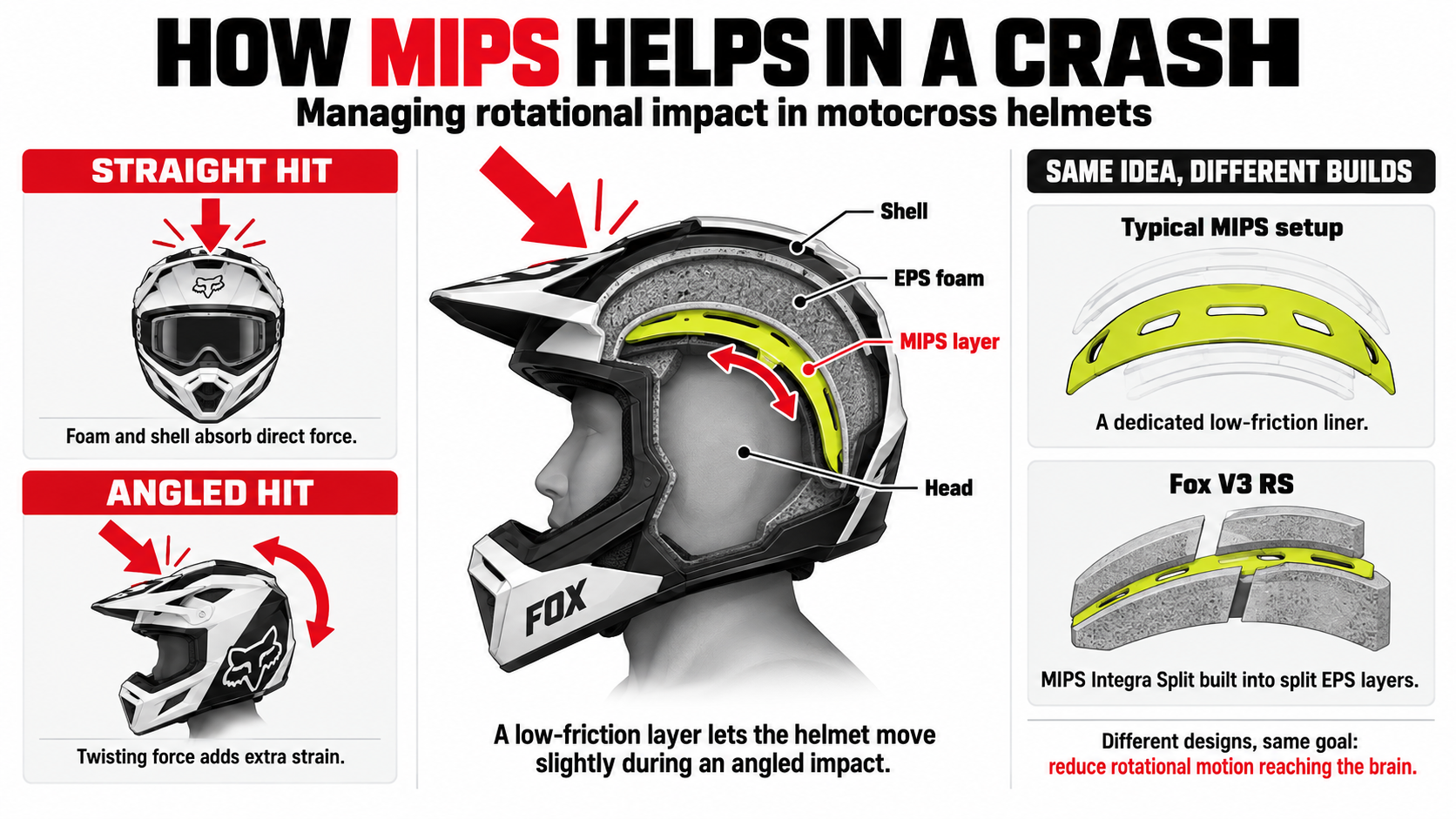
MIPS (Multi-directional Impact Protection System) addresses a specific failure mode: rotational motion. A straight-on impact and an angled, oblique impact put very different stress on your brain, and a helmet shell alone is built primarily to absorb the straight-on kind. According to MIPS's own technology explanation, the system adds a low-friction layer inside the helmet that lets the head move slightly during an angled impact, redirecting rotational motion away from the brain rather than letting the full force transfer directly.
Not every MIPS implementation is identical. The Fox V3 RS uses what it calls MIPS Integra Split, combining two separate layers of EPS foam rather than a single slip-liner, aiming to manage rotational force through the foam structure itself. Both approaches are real, licensed implementations of the same underlying MIPS technology (now used across more than 150 helmet brands worldwide), just engineered differently by each brand's helmet team.
Lightweight Shells: Carbon Fiber vs Fiberglass Composite
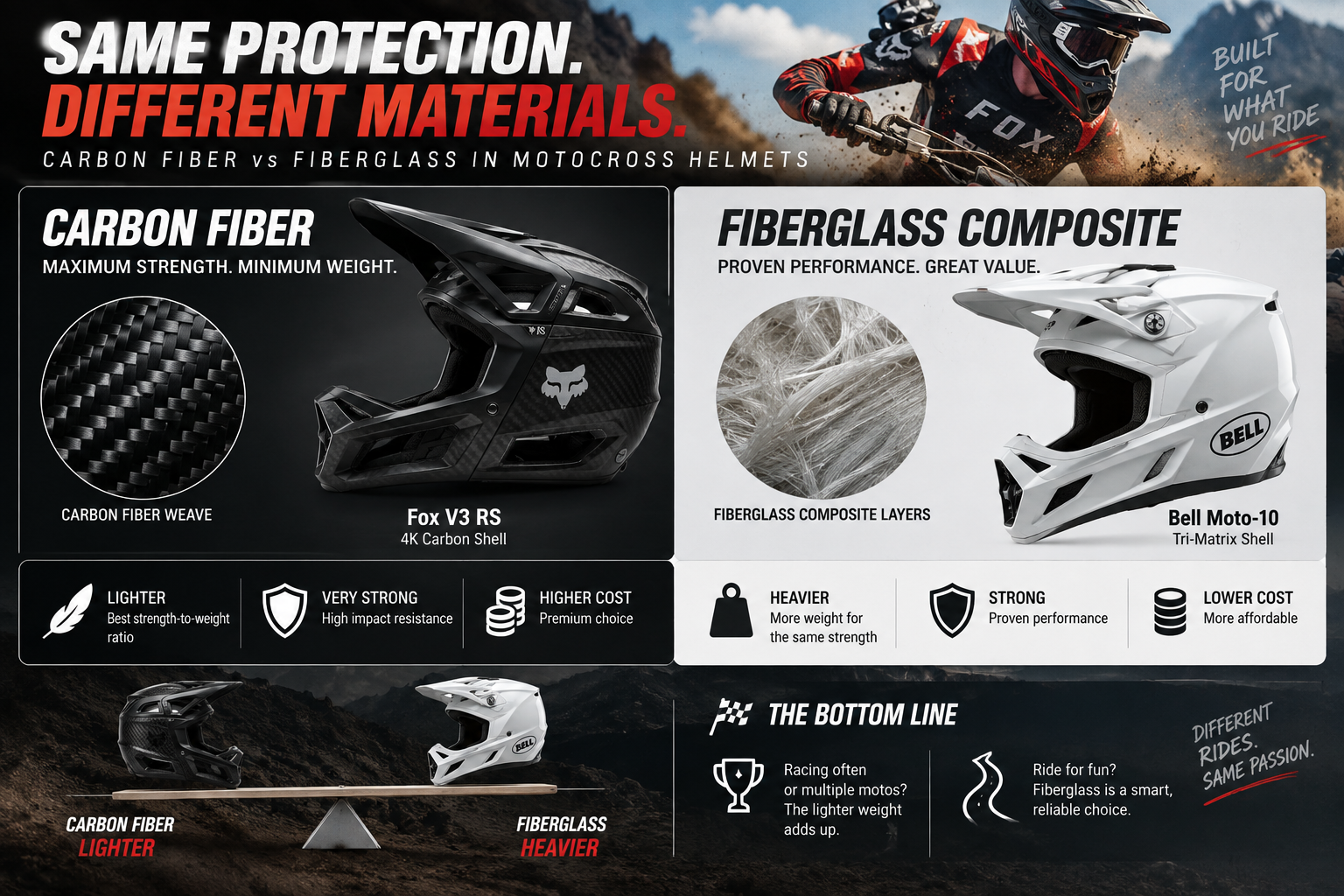
Shell material is where the price gap between these tiers actually comes from. Carbon fiber, like the Fox V3 RS's 4K carbon shell, offers the best strength-to-weight ratio of any material in common use, which matters directly for neck fatigue over a long moto or a full day of riding.
Fiberglass composite, like Bell's Tri-Matrix shell on the Moto-10, is heavier for the same strength but costs meaningfully less to produce, which is exactly why it shows up more often at the mid-tier price point rather than the top.
The weight difference is real but worth keeping in perspective: it's noticeable over a full moto, not necessarily something you'd feel picking up two helmets side by side in a shop. If you're racing competitively or riding multiple motos in a day, that difference compounds; if you're riding recreationally once a week, a fiberglass composite shell at a lower price point is a completely reasonable choice.
Ventilation and Visor Design: Small Details, Real Differences
Motocross riders generate significantly more body heat than street riders, standing and working the bike through rough terrain rather than sitting still, so ventilation design carries more real weight in MX helmets specifically. The Fox V3 RS uses four strategically placed exhaust vents on top of the shell; look for a similar intake-and-exhaust vent setup on any helmet you're comparing, not just a count of how many holes are in the shell, since placement affects airflow more than raw vent count.
Visor design matters for a less obvious reason than styling: a proper breakaway visor is designed to detach cleanly if it snags on something in a fall, rather than staying rigidly attached and transferring that snag force to your neck. Bell's Flying Bridge visor and Fox's 3-position breakaway visor both address this, though the specific breakaway mechanism differs between brands.
Fly Racing and Troy Lee Designs: Where They Fit In
Fly Racing and Troy Lee Designs both round out the MX helmet market with real, established lineups, worth understanding even where we don't have a directly confirmed Perf-Moto product link for every specific model.
Troy Lee Designs has been building motocross gear since 1981, founded by Troy Lee himself starting as a custom helmet painter in Corona, California, and now co-owned alongside investment partners Fasthouse, according to public company records. Their current moto helmet lineup runs three tiers: the SE5 at the top (carbon or composite shell, MIPS Integra, 1300 to 1470 grams depending on shell), the SE4 as a strong mid-tier option with MIPS and heavy ventilation, and the GP series as their more accessible entry point.
Fly Racing is a similarly established name in the space, known for competing well on value across entry and mid-tier price points without necessarily chasing the same carbon-fiber flagship tier as Fox's V3 RS or Troy Lee's SE5.
For both brands, browse the MX/Off-Road helmet filter to check current stock, or contact the team directly if a specific model isn't showing.
Frequently Asked Questions
Are Troy Lee helmets any good?
Yes, genuinely. Troy Lee Designs has been building motocross helmets since 1981 and has a long track record with professional racers, which is a meaningful signal in a sport where the same helmets get tested at genuinely high speeds and impact forces. Their SE5 and SE4 lines both carry MIPS and modern certification standards, putting them in the same conversation as Fox and Bell at comparable price points.
Who owns Troy Lee?
Troy Lee Designs was founded by Troy Lee himself in 1981 and remains a privately held company, now co-owned alongside investment partner Fasthouse. It's headquartered in Corona, California.
Which bike helmet brand is best?
No single brand wins outright across every category. Fox and Troy Lee both push hardest into premium carbon-fiber flagship helmets; Bell competes well across a wide range from mid-tier to premium, and also carries AGV and Arai in Perf-Moto's broader helmet catalog for riders wanting even more premium options; Fly Racing tends to focus on strong value at accessible price points. The better question is which specific model's certification, shell material, and fit match your budget and how often you ride.
What are the top 5 helmet brands?
We won't hand you an arbitrary ranked list, since a real top-5 needs comparative crash-test data and current market share numbers we don't have in front of us. What we can tell you confidently: Fox, Bell, Fly Racing, and Troy Lee Designs are all well-established, MIPS-equipped, properly certified options, and the right one for you depends on matching shell material and price tier to your riding frequency, not chasing a brand ranking.
Real Specs, Real Prices, No Guesswork
Marketing copy can say whatever it wants about being "the most advanced helmet ever," but certification standards, shell material, and actual current pricing don't lie, which is why this guide leaned on real listings rather than brand talking points. Perf-Moto carries MX helmets across all four of these brands, so the comparison here reflects what's actually available to buy, not just what's easiest to write about.
Questions about sizing or a specific model's current stock? Ask the team, Monday through Friday, 9 am to 5 pm EST.
Shop motocross helmets and compare shell material, MIPS implementation, and price directly.