
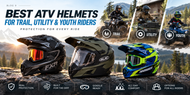
Finding the best ATV helmet starts with a question most riders never actually get a clear answer to: is an ATV helmet really its own category, or is it just a dirt bike helmet with a different name on the box? The honest answer shapes everything else in this guide, from ventilation to goggle compatibility to how you size a helmet for a kid who's still growing into the sport.
Browse Perf-Moto's ATV and off-road helmet lineup as you read through what actually matters.
Quick Takeaways
- ATV helmets and dirt bike helmets are mostly the same style, not two separate categories. The real distinction that matters is open-face-with-goggles versus full-face-with-shield.
- Ventilation matters more on an ATV than people expect, since you're working physically and generating heat even though the vehicle itself does the moving.
- Breakaway visor screws are a real safety feature, not just a styling detail, since a rigid visor that snags in a fall transfers force straight to your neck.
- Swappable cheek pads let you fine-tune fit within one size, which matters more on ATV helmets than most riders realize before their first long trail day.
- Youth ATV helmets need real youth-specific sizing, not just a smaller version of an adult shell.
ATV Helmets vs. Dirt Bike Helmets: Are They Actually Different?
Here's the honest answer: mostly, no. What's marketed as an "ATV helmet" is typically the same open-face, MX-style helmet built for dirt bikes, with a large eyeport designed specifically to accommodate goggles rather than an integrated face shield. The real category split isn't ATV versus dirt bike; it's MX-style versus street-style.
MX-style helmets (the kind used across dirt bikes, ATVs, and side-by-sides) prioritize airflow and a wide field of view, relying on goggles rather than a shield for eye protection, since goggles create a sealed foam barrier against dust and debris that a street helmet's visor genuinely can't match in off-road conditions. Street-style helmets prioritize aerodynamics and quiet at speed, with an integrated shield instead of goggles.
If you're cross-shopping ATV gear against a street helmet you already own, understand that you're comparing two fundamentally different designs built for different problems, not two versions of the same thing.
Ventilation: Why ATV Riding Demands More Airflow
It's easy to assume that since the ATV is doing the physical work of moving, ventilation matters less than it does for a dirt bike rider actively working the bike through rough terrain. That assumption doesn't hold up in practice. ATV riding on rough trails is still physically demanding, and the seated position doesn't get the same airflow across your body that standing on pegs and leaning into corners does on a bike.
Perf-Moto's Fox Racing V1 Xpozr is a genuinely well-ventilated option built specifically with this in mind, using 7 intake vents and 4 exhaust vents to actively channel air through the shell rather than relying on passive airflow alone. It's also explicitly rated by Fox for use across dirt bikes, ATVs, and side-by-sides, with an optional cold-weather kit sold separately if you ride into colder months on the same helmet.
Visor Design and Breakaway Safety
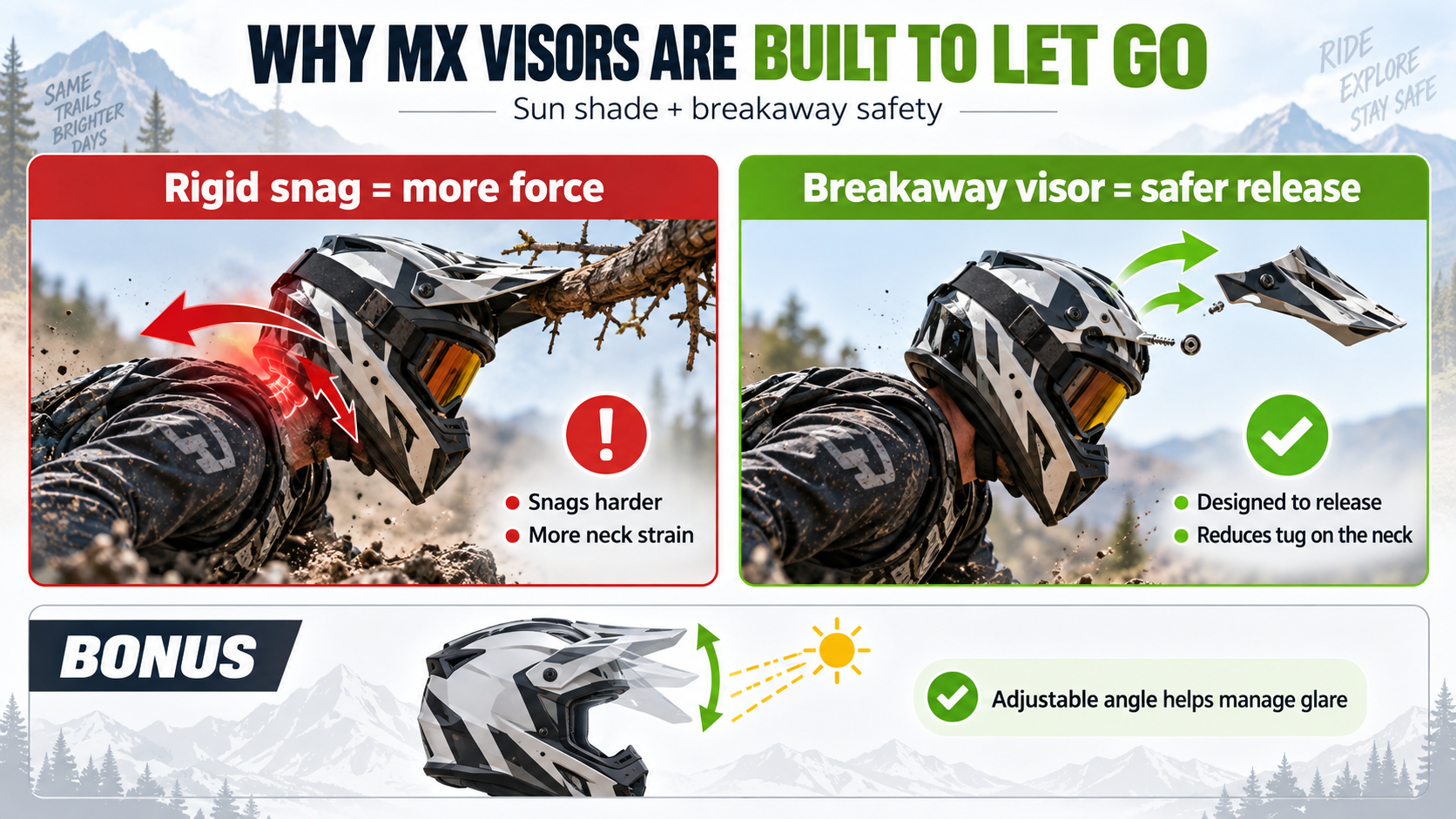
A visor on an MX-style helmet does more than block sun and deflect a little debris; a properly engineered one is designed to detach cleanly if it snags on something during a fall, rather than staying rigidly attached and transferring that snag force directly to your neck. The Fox V1 Xpozr specifically uses breakaway side screws on its adjustable visor for exactly this reason, a small detail that matters more than it looks like it would the one time it actually gets tested.
Beyond the safety function, an adjustable visor angle helps manage glare on bright trail days and gives you a small amount of control over airflow hitting your goggles, which matters more than people expect when you're riding directly into afternoon sun on an open trail.
Goggle Compatibility and Fit Customization
Since MX-style ATV helmets are built around goggles rather than a shield, the eyeport shape and depth matter for compatibility, and most goggles on the market are built to work with this style of helmet without much fuss. What's less obvious is how much you can fine-tune the helmet's own fit once you've got the right size.
The Fox V1 Xpozr, for example, ships with four shell sizes and six EPS liner sizes across nine total helmet sizes, and lets you swap cheek pads between thick and thin versions to adjust fit by about 5mm in either direction without buying a different size shell entirely. That's a genuinely useful way to dial in fit if you're between sizes on a standard chart, rather than settling for "close enough" in one direction or the other.
Youth ATV Helmets: Sizing for Young Riders
Youth ATV helmets need to be genuinely youth-engineered, not just an adult shell scaled down, since kids' head proportions and neck strength differ meaningfully from adults'.
Perf-Moto's Answer AR1 Sweep Youth helmet is built specifically for younger riders, meeting or exceeding both DOT FMVSS 218 and ECE 22-05 standards, with a dual-density EPS liner designed to absorb both large and small impacts and a ventilation system with multiple intake and exhaust ports to help manage heat on warmer trail days.
It comes in youth-specific S, M, and L sizing, with a removable and washable liner and cheek pads, useful for a piece of gear that's going to see genuinely hard use.
Frequently Asked Questions
What is the best helmet for ATV trail riding?
For general trail riding, an MX-style helmet with strong ventilation and a properly engineered breakaway visor covers most of what matters. The Fox Racing V1 Xpozr is a solid example: DOT and ECE 22.06 certified, MIPS-equipped for rotational protection, with 7 intake and 4 exhaust vents and adjustable fit through swappable cheek pads. There's no single "best" helmet across every rider, but that combination of certification, ventilation, and fit adjustability is what to prioritize regardless of which specific model you choose.
What is the best youth ATV helmet?
Look specifically for a helmet built and certified for youth riders, not an adult shell in a smaller size. The Answer AR1 Sweep Youth meets or exceeds both DOT FMVSS 218 and ECE 22-05 standards, with a dual-density EPS liner and real ventilation, at a genuinely accessible price point for a piece of gear kids will outgrow and need to replace as they get older.
What size ATV helmet should I get for my child?
Measure your child's head circumference with a soft tape measure about an inch above the eyebrows, then check that number against the specific brand's youth size chart rather than guessing based on age alone. Youth helmets are typically sized in small, medium, and large bands rather than a single continuous scale, and sizing varies between brands the same way adult helmet sizing does, so always check the specific product's chart before buying.
Which is the No. 1 helmet brand?
No single brand holds that title, and treat any answer that names just one with some skepticism. Fox and Answer both make well-certified, properly ventilated ATV and off-road helmets at different price points and with different feature sets. The better question is which specific model's certification, ventilation, and fit actually match how and where you ride, not which brand name is on the shell.
Gear Built for the Trail, Not Just the Photo
An ATV helmet has to handle dust, heat, and real impact risk all at once, which is exactly why certification, ventilation, and genuine fit adjustability matter more here than styling. Perf-Moto carries ATV and off-road helmets across trail, utility, and youth sizing, built around what actually happens out on a trail rather than what looks good on a shelf.
Not sure which helmet fits your riding or your kid's? Ask the team, Monday through Friday, 9 am to 5 pm EST.
Shop ATV and off-road helmets and compare ventilation, certification, and sizing directly.