
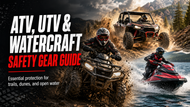
Three very different vehicles, three different sets of risks, and one thing they all share: none of them come with airbags, crumple zones, or the built-in protection you'd expect from a car. This ATV and UTV safety gear guide covers what actually matters for all three, since "ATV gear" and "UTV gear" and "watercraft gear" aren't interchangeable the way people sometimes assume when they're new to off-road and on-water riding.
An ATV rider steers and balances with their whole body the way a dirt bike rider does. A UTV has a steering wheel, seatbelts, and a roll cage, closer in spirit to a small off-road car.
A jet ski or PWC puts you in direct contact with water at speed, where the primary danger isn't a fall onto dirt but ejection into water, sometimes at speeds that make that landing hit harder than people expect.
This guide breaks all three down separately: the personal protective gear you wear, and, for UTVs specifically, the vehicle's own built-in safety features that work alongside your gear rather than instead of it. You can browse Perf-Moto's off-road and watersports gear to see the full range as you read through what you actually need.
Quick Takeaways
- ATV and UTV safety gear overlap heavily but aren't identical. ATVs demand the same active, body-steering protection as dirt bikes; UTVs add seatbelts and a roll cage to the equation, which changes what your personal gear needs to cover.
- A helmet is non-negotiable on an ATV, strongly recommended on a UTV, even though a UTV's cage and seatbelt reduce some of the risk a helmet on an ATV is entirely responsible for covering.
- UTV seatbelts only work if you wear them. Industry safety data consistently points to unused seatbelts, not the absence of a roll cage, as the leading factor in UTV rollover injuries.
- PWC riders need a specific type of life vest, not just any life jacket pulled from a general boating bag. Inflatable vests are prohibited for personal watercraft use in most states.
- Goggles matter as much as helmets for ATV riders in dusty or muddy conditions, the same way they do for motocross.
What Safety Gear Do I Need for an ATV? The Complete List
ATVs are rider-active vehicles: you steer and balance using your whole body, shifting weight the way a dirt bike rider does, which is why ATV protective gear closely mirrors motocross gear.
- Helmet. Full-face, off-road specific, the single most important piece of gear on the list.
- Goggles. Sealed against dust and mud, the same reasoning as motocross riding.
- Gloves. Grip and lever feel matter more than heavy armor here.
- Boots. Over-the-ankle, rigid enough to protect against footpeg impact and rollover.
- Chest protector or body armor. Optional for casual trail riders, closer to essential for anyone riding aggressively or racing.
- Long sleeves and pants regardless of weather. Exposed skin against dirt, rocks, and brush at speed is a bad trade for staying cool.
Browse ATV and off-road apparel, shared with dirt bike and motocross riders since the terrain and hazards overlap closely.
UTV Safety: Personal Gear Plus Built-In Vehicle Protection
This is where UTV safety diverges meaningfully from ATV safety, and it's worth understanding both halves of the picture.
What is UTV equipment, structurally speaking?
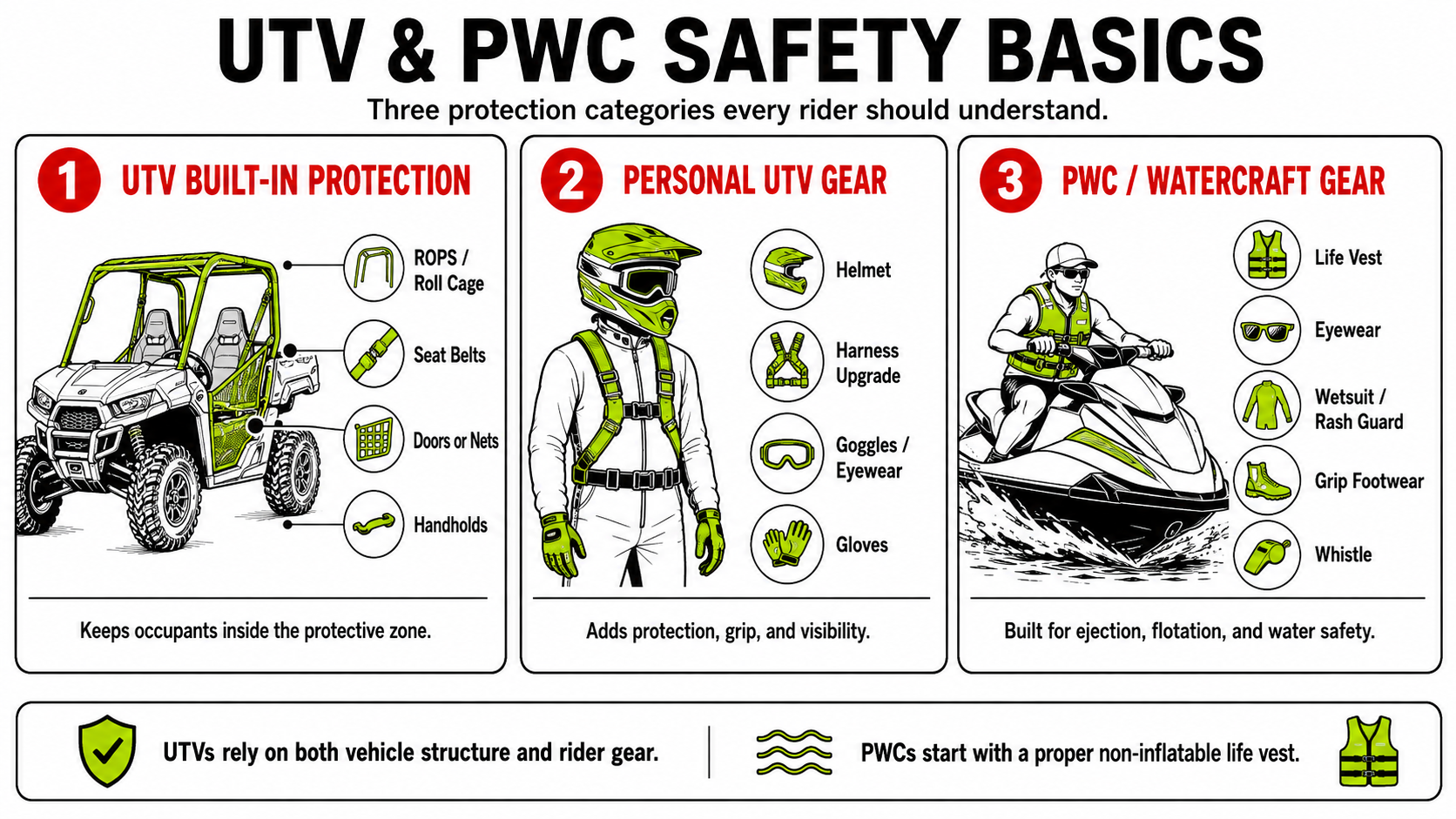
According to the Recreational Off-Highway Vehicle Association (ROHVA), UTVs (also called ROVs, for Recreational Off-Highway Vehicles) are defined by a specific set of built-in features: a steering wheel instead of handlebars, foot pedals instead of hand levers, bench or bucket seating instead of straddle seating, and, critically, a rollover protective structure (ROPS), seat belts, and side retention features like doors or heavy-duty netting. None of that is optional personal gear; it's engineered into the vehicle itself.
What are the safety features of a UTV?
The four that matter most:
- ROPS (Rollover Protective Structure). The roll cage. It's certified to specific standards and shouldn't be modified or removed, since the roof and structural bars are part of what keeps the cage's protective zone intact during a rollover.
- Seatbelts. This is the feature that actually determines whether the ROPS does its job. Safety researchers who've studied UTV rollover incidents have specifically identified unused seatbelts, not a missing or inadequate ROPS, as the leading factor in preventable UTV injuries. The cage only protects you if you're still inside its protective zone when the vehicle rolls, and a seatbelt is what keeps you there.
- Doors, nets, or shoulder barriers. Side retention features that keep arms, legs, and upper bodies inside the vehicle's protected zone, which matters because instinctively bracing an arm or leg outward during a rollover is exactly what these features are designed to prevent.
- Handholds. Passenger-side grab points that reduce the instinct to brace against the dash or door frame during rough terrain.
Personal gear on top of the vehicle's structure:
- Helmet. Less universally mandatory than on an ATV given the roll cage, but still strongly recommended, especially for higher-speed or performance UTV driving where the cage protects against a rollover but not necessarily against smaller impacts inside the cabin.
- Harness upgrade. Stock UTV seatbelts are typically a standard 3-point automotive-style belt. Performance and racing UTVs often upgrade to a 4-, 5-, or even 6-point harness, which distributes crash force across the shoulders, hips, and sometimes between the legs rather than concentrating it across one lap-and-shoulder line. If you're running a UTV hard or racing it, a harness upgrade is worth researching specifically for your model, since fitment varies a lot between manufacturers and cage designs.
- Goggles or eyewear. UTVs kick up dust just like ATVs, even with a windshield, especially for rear passengers.
- Gloves. Improves wheel grip and reduces vibration fatigue on long rides, similar logic to any powersports gloves.
Shop helmets, goggles and eyewear, and gloves for UTV driving. Harnesses are a specialty item that varies significantly by cage design, so contact Perf-Moto's team directly if you don't see the right fitment listed and they can help track down the correct part for your specific UTV.
Watercraft and PWC Safety Gear: Life Vests and Beyond
Personal watercraft (PWC), jet skis, and similar craft put you in a genuinely different risk category than ATVs or UTVs: the primary danger is ejection into water at speed, not a fall onto solid ground.
Life vests are the single most important piece of PWC gear, and the requirements are specific enough that not just any life jacket satisfies them. According to BoatUS Foundation, PWC riders need a Coast Guard-approved, non-inflatable vest, typically Type III, which offers a practical balance of buoyancy and freedom of movement for an activity where you're actively steering and shifting your weight. Inflatable life jackets are explicitly prohibited for PWC use in many states, mainly because they take time to trigger and inflate, time you don't have during a high-speed ejection into water.
Beyond the life vest itself, a full PWC safety kit includes:
- Impact-rated eyewear. Protects against spray and glare at speed, distinct from the goggles used for dirt riding.
- Wetsuit, rash guard, or board shorts. Depends on water temperature and how often you expect to end up in the water rather than on the craft.
- Footwear with grip. Wet decks and launch ramps are genuinely slippery, and bare feet offer no protection if you step on something sharp entering or exiting the water.
- Whistle or signaling device. Attached to the life vest itself, standard practice for any water sport where you might need to signal for help at a distance.
Browse watercraft safety gear for life vests built specifically for PWC use, and watersports apparel for wetsuits, rash guards, and everything else you'll wear in and around the water.
Frequently Asked Questions
What are the safety considerations for ATVs, beyond just gear?
Gear is one piece of a larger picture. Age-appropriate sizing matters a lot, since an ATV that's too large or powerful for a young or inexperienced rider is a real risk regardless of how good their gear is. A hands-on safety course before riding unfamiliar terrain makes a meaningful difference, since a lot of ATV incidents come down to unfamiliarity with how the vehicle handles on varied ground rather than a gear failure. Riding with at least one other person on unfamiliar or remote trails, rather than alone, is also a genuinely underrated safety practice, mainly because it means someone's there if something goes wrong far from help.
Is an ATV manual or automatic?
Both exist. Most modern recreational and utility ATVs use an automatic CVT (continuously variable transmission) that you simply put in gear and ride, no clutch involved. Sport quads and some older or racing-oriented models still use a manual clutch and foot-shifted gears, closer to a motorcycle transmission. If you're new to ATVs, a CVT automatic is generally the easier and more forgiving place to start.
When should I use high gear on an ATV?
High range is for open trails and higher speeds, where you don't need extra torque and want a smoother, faster ride. Low range is for technical terrain, steep hills, towing, or anything requiring more torque at low speed, since low range trades top speed for pulling power. Running in the wrong range consistently, especially high range at low speeds, tends to wear out the belt and clutch faster than necessary, so when in doubt, check your specific model's owner's manual, since the exact speed thresholds for switching ranges vary meaningfully between makes and models.
What is UTV equipment, in simple terms?
The vehicle itself comes equipped with a roll cage (ROPS), seatbelts, and side retention features like doors or nets, all built in structurally rather than worn. On top of that structural equipment, riders typically add personal gear: a helmet, goggles, and gloves, plus a harness upgrade for anyone driving a UTV hard or competitively.
Riding Since '97: Gear That Actually Fits the Way You Ride
Perf-Moto started as a brick-and-mortar motorsports shop in Holland, Michigan back in 1997, before moving fully online. That background shows up in how the site is built: free domestic shipping, a guaranteed-fitment policy, and a lowest-price guarantee, because gear that doesn't fit or ship on time doesn't help anyone ride. Perf-Moto carries ATV, UTV, and watercraft safety gear across dozens of brands, so recommendations here are about what actually protects you, not about pushing one label over another.
Questions about sizing, fitment, or an order? Contact Perf-Moto's team. They're real humans, Monday through Friday, 9am to 5pm EST.
Ready to gear up? Shop the full ATV, UTV, and watercraft lineup at Perf-Moto and filter by activity, brand, or price.